

The Brand Architecture: Connecting All the Dots
Fragmented marketing, siloed departments, and piecemeal agency work destroy luxury brand equity. In this insight, luxury hospitality strategist Marian Gómez explores why luxury assets fail when built in parts—and how The Brand Architecture™ method connects brand strategy, team engineering, and commercial operations under one unified vision for hotels, wellness resorts, and longevity holdings.
Photo credit: Georges Seurat, Circus Sideshow (Parade de cirque), 1887/88, The Metropolitan Museum of Art. Thousands of dots that only make sense together, under one eye. The “parade” was the small free show held at the circus entrance to attract the audience to buy a ticket. It is the shop window, not the performance. Like brands, which are not only a facade.
A branding agency delivered the identity. A consultant delivered the strategy deck. A marketing hire delivered the campaigns. Each piece is competent. None of them talk to each other.
It is a patchwork. It looks good, I will not deny it. But the reality is a collection of good actions, not a Goya, a Velázquez or a Picasso painted with one objective, one perspective, and one line set by a single conductor. What it produces is disconnection: layers stacked on top of each other instead of one piece in tune. I have nothing against patchwork. You get the point.
That is not bad luck. That is what happens when a brand is bought in parts.
After two decades inside the biggest conglomerates in the hospitality industry, the most renowned tourism holdings and wellness brands, I have seen the whole picture from the inside, and I still see it today. Most of the companies do not operate as one company. Each area works as its own isolated company, sharing “things”.
I never believed in this way. In very short words for a complex thing, my work is perspective, and how I work is connecting all the dots. I was already doing it as an intern, twenty years ago. In industry jargon, it is my “intellectual property”, my professional/personal brand, and everyone has their own. I believe each one should offer what they feel is their “watermark”.
Basically, when someone asks for something in particular, it is complicated to explain why these actions and this strategy and no other, because the whole spectrum I need to contemplate is impossible to explain in a board meeting. We try, in simple words, with some simple information, but in blunt terms, at this point the most relevant thing is who is receiving the information, how open minded they are, and whether the founder, the investor, or the CEO (not a Chief Everything Officer keeping their hands in every single small and insignificant detail) is open to it.
I always remember, and I mentioned it in one of my very first articles on this blog, Insights, when one of the Global Directors brought up in an ExCom meeting including a small, tiny advertisement in a newspaper in Canada, with no sense other than a romantic and nostalgic approach. I really respect them as a professional, but I still almost black out every time it jumps into my mind.
What The Brand Architecture™ is
The Brand Architecture™ is the strategic methodology of Marian Gomez Consulting. It integrates three disciplines into one system for luxury hospitality, tourism, wellness, and longevity brands: Brand Strategy, Strategic Advisory, and the Fractional CMO. Each one solves a specific problem. Together, they let a brand hold its value beyond the next campaign.
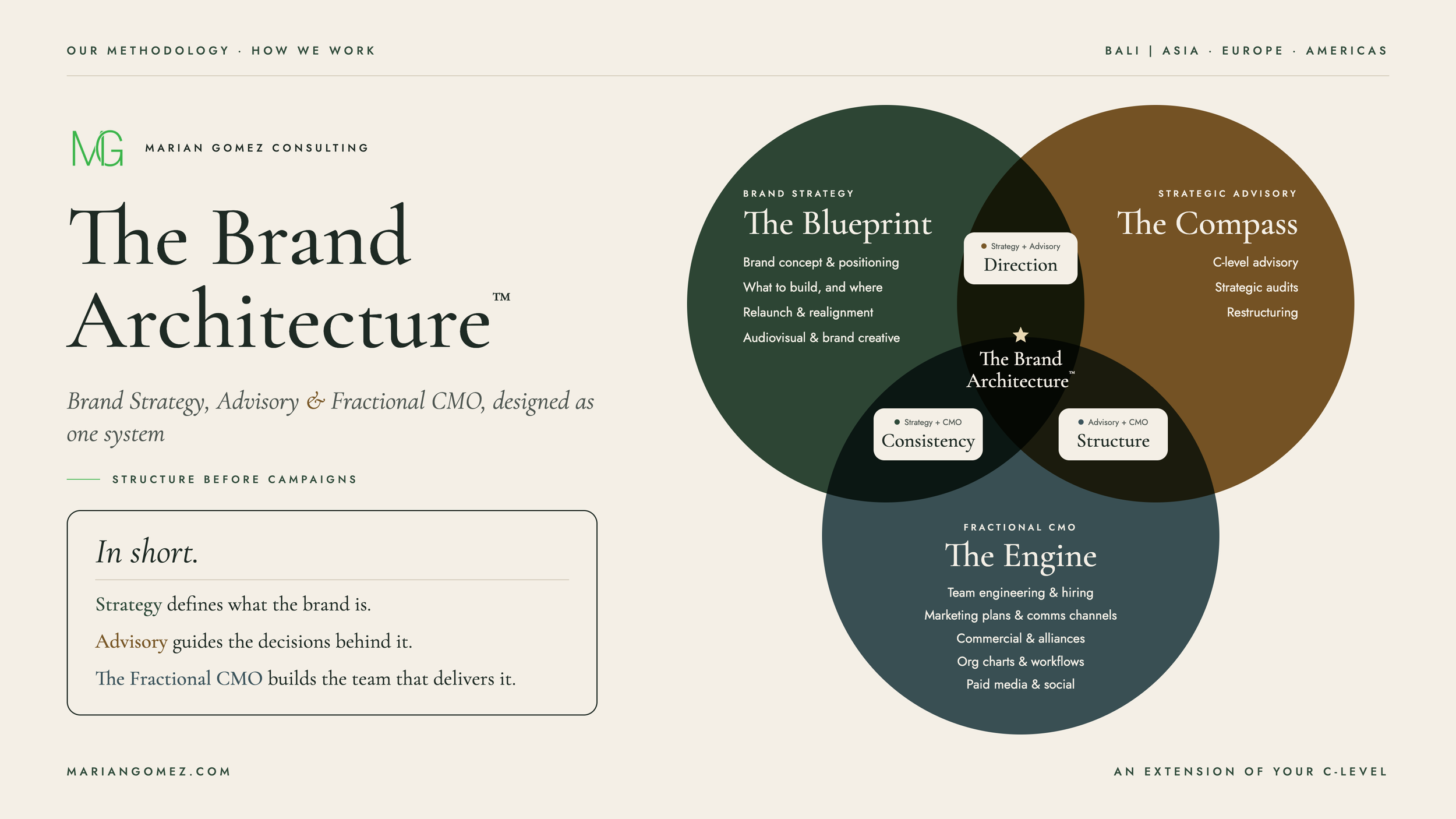
The Blueprint: Brand Strategy
What the brand is, and where it should live. Brand concept and positioning, what to build and in which market, relaunches and realignments when a brand has lost the thread, and the audiovisual and creative work that makes it visible. This is where we decide what you refuse to be, which is usually worth more than what you claim.
Usually nobody knows exactly what they need. They rarely do. But with our knowledge and conversations, we understand it from the first moment, from a humble and caring position. Sometimes it is a small tweak, sometimes the service or brand is not clear, sometimes they don’t know exactly who their target audience is, or where it is and how to attract it.
The Compass: Strategic Advisory
The decisions behind the brand. C-level advisory, strategic audits, restructuring. This is the seat at the table where an investor asks whether the longevity wing is a business or a brochure, and gets a straight answer.
This is probably one of the most delicate points. The conversation usually turns into a “professional vulnerable position”. Nobody loves to talk about needing help in some way, because sometimes it looks like a step back. But the reality is that everyone in the industry has it, and usually, the bigger the company, the more firms and consultants it has... to cover and support their teams. How you see the business, how to push, teaching about the industry, advising on the best moments, alliances, partnerships, PR movements... I am literally the shadow and the person at their back.
The Engine: Fractional CMO
The team that delivers it. Team engineering and hiring, marketing plans and communication channels, commercial strategy and alliances, org charts and workflows, paid media and social.
This is like a “messy room” where we accommodate with sense. Reusing things with a better purpose, giving the name and the sense to the room, removing the old and useless, and buying new things when it is necessary. It is a deep clean.
Strategy that nobody can execute is a very expensive PDF.
Where the value actually sits
The disciplines matter. The intersections matter more.
Strategy and Advisory together give you direction. Strategy and the CMO function give you consistency: the same brand on the website, in the sales deck, and at the reception desk. Advisory and the CMO function give you structure, an organization designed to execute instead of improvise.
Remove one circle and you can see exactly where it breaks. Positioning without an engine stays on the mood board. An engine without a compass runs fast in the wrong direction. Advice without a blueprint is just opinion.
Who it is built for
Founders building a hotel, retreat, or longevity concept who want the business designed before the logo. Family offices and holdings that need an asset worth going to, not just worth owning. Operators whose product is excellent and whose brand no longer says so.
We work from Bali with clients across Asia, Europe, and the Americas. Ibiza, Mallorca, Madrid, Southeast Asia. The geography changes. The fracture is almost always in the same place.
How a project starts
With a conversation. The proposal comes from understanding what is really happening, not only from what was asked.
Sometimes it is all three. Sometimes it is one circle and a very open conversation.
We do not replace your C-level. We act as an extension of it.
If you want to get in touch with us, you can do it through the contact section on our website, and we will organize a call. Not a sales call, not a consultancy session. A call to get to know each other, to see if there is space for a mutual conversation about collaborating, and then to send you an ad hoc proposal.
The form is brief, but it is there for a reason: to keep out bots and spammers, which is quite usual in the digital world. It keeps our time for the people who are actually in the industry. Or, if you prefer, you can contact me or my team directly on LinkedIn, through my personal profile, or on the Marian Gomez Consulting page.
For those who want to go further, there is now a Founding & Advisory Membership: an annual membership for continuous strategic guidance, with articles written only for members AND a monthly 50 minute 1:1 call. Places are limited, and not only in number. Each request is reviewed before a place is offered. When you apply, select “Founding & Advisory Membership” in the form.
I am Marian Gómez, Founder of Marian Gomez Consulting, a boutique strategic advisory with senior professionals for luxury hospitality, wellness, and tourism brands and holdings, based in Bali, advising clients across Asia, Europe, and the Americas. Our methodology, The Brand Architecture™, builds integrated brand ecosystems where brand, experience, operations, culture, narrative, and revenue function under one unified strategic vision.
I also write The Brand Architecture, my newsletter on Substack, for founders, investors, and leadership teams in luxury hospitality, tourism, wellness, and longevity. The same strategic thinking, with a slightly drier sense of humor and a little less polish. It is free, because I believe knowledge should be accessible.

The Battle Against Misinformation: The Cost of Leading in the Era of Fragmented Attention
Learn the essential digital marketing strategies to scale your business, automate processes, and increase your revenue with a solid plan.
Why luxury hospitality brands verify Michelin stars but not wellness credentials—and how new global regulations are about to force a reckoning.
Two international luxury hotel chains—if I told you the names, you’d fall off your chair—have in their roster of ‘wellness experts’ a holistic coach without verifiable medical training and a ‘holistic nutritional coach’ without nutrition studies. Both offer workshops to guests paying over €1,500 per night.
The selection criteria? Likes and engagement rate.
Credential verification? None.
Remember the meme of Snoop Dogg dressed as a surgeon in an operating room? It’s not far from reality. Except in this case, the ‘patients’ are paying luxury prices for the privilege.
The question nobody asks: Why do we verify Michelin stars but not wellness credentials?
In luxury hospitality, we’re obsessive about credentials where it matters. Executive chef: verifiable training, years of experience, perhaps Michelin stars. Sommelier: WSET certifications, Court of Master Sommeliers. Spa therapists: licenses, certifications in specific techniques. Concierge: Les Clefs d’Or, years of training.
But when it comes to wellness coaches, holistic healers, nutritional advisors, the selection criteria changes radically: Instagram followers plus engagement rate. Verification: do they have a professional website? Do their posts look good?
Why? Because we confuse reach with expertise.
The luxury problem is unique (and existential)
These hotels, tourist destinations, and lifestyle brands aren’t being malicious. They’re being human in 2025: information overload, scanning instead of reading, trusting vanity metrics (followers) instead of substance metrics (credentials).
It’s exactly the problem that Queen Letizia of Spain recently articulated: without the capacity for deep reading—in this case, deep due diligence—we cannot distinguish between what seems legitimate and what actually is.
And here’s the twist the industry doesn’t see coming: China saw it first. That’s why it’s now law that influencers in wellness, nutrition, and health must have verifiable credentials. It wasn’t moralism. It was consumer protection after documented cases of health influencers causing real harm.
Europe is heading in the same direction. Australia is protecting minors from the same ecosystem of unverified influencers.
And what are luxury tourism and lifestyle companies doing? Waiting to become the case study in the next regulation.
What Harvard Business Review doesn’t address
Harvard Business Review published in its September-October 2025 edition an article titled “How to Counter Fake News,” presenting a three-part framework for corporations: monitor social resonance to identify fake news early, ensure transparency with stakeholders before crises, and activate credible allies to reinforce the truth.
But there’s a prior problem the article doesn’t address: what happens when you yourself are amplifying unverified information?
When your hotel, tourist destination, or lifestyle brand promotes a wellness expert without verifying their credentials, you don’t need to monitor external fake news. You are the source. And no crisis management framework will save you when a client suffers harm following advice from your holistic nutrition coach without nutrition training.
The abandoned verification epidemic
Here’s the connection nobody is making: the same problem that makes your teams not read complete briefings is what makes them not verify influencer credentials.
I see this every day: I send a strategic plan and nobody reads it completely. I send 40-page brand guidelines and they run it through AI for a summary. They propose an influencer partnership and nobody verifies beyond the media kit.
The epidemic isn’t fake news. It’s abandoned verification. We’ve outsourced our critical thinking to metrics (followers equals credibility) and to AI (summary equals comprehension).
And in luxury, this is brand suicide. Because your client paying €2,000 per night or per experience will verify. Will investigate. And when they discover your wellness expert has a certificate from a 6-week online course, how much do you think your brand equity is worth?
The global signals marketing departments must understand
China now requires professional credentials for influencers on certain topics. Implication for brands: your brand ambassadors will need real validation. B2B isn’t exempt: does your company validate the credentials of its thought leaders? For hotels, tourist destinations, and luxury lifestyle brands that depend on the Chinese market—representing 40% of global luxury travel spend—this isn’t a suggestion. It’s law.
Australia has banned social media for minors under 16. Implication: forced segmentation, changes in acquisition strategies. Brands lose access to an entire generation in formation.
Queen Letizia of Spain’s quote about how reading doesn’t just give emotional vocabulary, it gives critical thinking. Without it, your audience is vulnerable to any narrative. In luxury, you sell articulated emotion: transformative experience, curated journey. If your audience cannot process complex narratives, they cannot genuinely aspire to your product.
Three real scenarios you face today
Scenario A: The wellness influencer without credentials promises healing retreats at your resort, transformative experiences at your destination, or workshops at your lifestyle brand. They have no medical training. Someone gets sick following their advice. Your brand appears in the lawsuit. Cost: Legal plus reputational equals incalculable.
Scenario B: The family that can’t research your experience receives 47 newsletters, 200 emails, infinite ads. They use AI to summarize reviews. The AI loses the critical nuance of “exceptional service but not recommended for small children.” They arrive with wrong expectations at your carefully curated experience. Cost: Bad review plus customer service nightmare.
Scenario C: Your own team doesn’t read your brand guidelines. You create a 40-page brand book (standard in luxury). Marketing team runs it through ChatGPT for summary. They lose the nuance between understated elegance versus ostentatious luxury. They launch a campaign that contradicts brand essence. Cost: Brand dilution. And I’ve been noticing this more markedly in recent weeks at a general level—this isn’t an isolated case, it’s a growing trend.
And then there’s the other side
I currently support as fractional CMO a company in its repositioning as a wellness and longevity center. It’s not a large corporation with infinite budgets. But every cent of investment includes a non-negotiable line item: certified medical consultants and verified professionals.
Every program. Every treatment. Every claim we make in marketing.
The owner has a clear philosophy: less ribbon cutting, fewer Instagram photos, more real action. And it shows, you can breathe it in what they offer.
The result? A slower process. Meetings where doctors review every word of copy. Budgets that include verification costs that other brands spend on influencer gifting.
But here’s the bet: when regulations arrive—not if, but when—this company won’t have to change anything. While competitors enter panic mode restructuring partnerships and withdrawing claims, they’ll simply continue.
Because they built right from day one.
And in 5 years, when wellness and longevity are as regulated as pharma (which they will be), this company will be the reference. Not by accident. By strategic decision today.
This is what separates real luxury from performative luxury.
The framework for leaders: three questions you can’t avoid
When you hire a fractional CMO, you’re not just hiring marketing expertise. You’re hiring a reality filter that audits your influencer partnerships under new regulations: do your KOLs in China have mandatory credentials? Do your wellness influencers have real training? Can your food bloggers justify their health claims?
That protects your brand from fragmented information: creates brand narratives that survive AI summarization, ensures your team reads (really reads) your brand essence, implements the HBR framework adapted to luxury: monitor social resonance especially on WeChat and Xiaohongshu for Chinese market, transparency with stakeholders before crisis, activate credible allies (do you have partnerships with hospitality schools? Real certifications?).
That builds brand equity that resists misinformation: in luxury, you can’t clarify quickly on Twitter. You need deep relationships with specialized press. You need clients who understand your complete narrative (not a bullet point).
For owners of hotels, tourist destinations, and lifestyle brands: ask your marketing departments: do our influencers comply with new Chinese regulations? Do we have a crisis plan for when a partner is discredited?
For investors: the next due diligence must include: influencer credential audit, brand narrative resilience test, regulatory compliance by market.
For boards: the question isn’t how much we spend on marketing. It’s how much a preventable reputational crisis costs.
Snoop Dogg in an operating room is funny because it’s obviously false
A holistic coach without credentials giving nutritional advice at your €1,500 per night hotel, at your premium tourist destination, or at your lifestyle brand isn’t funny. It’s your next crisis. And unlike the meme, nobody’s going to laugh.
China understood this. That’s why they put regulations in place. Australia understood this. That’s why they’re protecting minors. The EU is going to understand it.
The question is: will your brand be the case study that accelerates those regulations, or will you be the one who verified before it was mandatory?
Because in luxury, being reactive isn’t an option. It’s a death sentence.
As a CMO and Strategic Advisor, I know influencers sell. I know engagement rate moves needles. I know holistic wellness is trending and generates bookings.
But I also know what I saw on the other side. The company I support—even without being a large corporation—invests every cent in verifying: certified medical consultants, professionals with real credentials, claims they can defend under regulatory scrutiny.
It’s slower. It’s more expensive in the short term. It’s infinitely more complex from a marketing perspective.
But it will be the global reference in 5 years. Not because they have more budget than international chains or major tourist destinations. Because when China, Europe, and the rest of the world implement regulations (which they will), they’ll already be in compliance.
While others rebuild from scratch—with all the reputational cost that implies—they’ll only have to say: “We always did it this way.”
That’s brand equity you can’t buy. You build it.
In 2026, selling luxury isn’t showing amenities or perfect destinations. It’s building unassailable credibility when nobody reads completely, when influencers need titles, when your best Chinese clients only trust certified KOLs.
Before launching your next campaign with that 500K follower influencer, ask yourself: do they have the credentials China now requires? Do I myself understand my brand’s complete narrative, or just the bullets?
Because in luxury, you’re not selling nights or experiences. You’re selling trust. And that doesn’t recover with a press release.
Want to connect? Find me on LinkedIn.
To learn more about what I do and what I offer as a fractional CMO, visit my services.

The Art of Resilience for Leaders: Flourish in the Hospitality, Tourism and Wellness Industry
In the last decade, few industries have been as hard hit and transformed as hospitality, tourism, and wellness. This article explores how leaders in these sectors have not only survived but thrived by embracing resilience as a core competency and a strategic business approach. It highlights the pivotal roles of strategic marketing, the Fractional CMO model, and strategic consulting in enabling brands to adapt, innovate, and connect with their audience amidst constant change.
In the last decade, few industries have been as hard hit and transformed as hospitality, tourism, and wellness. From global pandemics to economic crises, natural disasters, technological changes, and transformations in consumer values, sector leaders have navigated more than turbulent waters.
And yet, here they remain. What's the key to their success? Reinventing, sustaining teams, redesigning experiences and, in many cases, emerging stronger. They have achieved this through a competency that is no longer optional: resilience.
Why is resilience a critical topic today?
Because the unexpected is no longer the exception. It's the norm. Economic volatility, climate change, destination saturation, regulatory pressure, new consumption habits and digital acceleration have redefined the context. And in this context, leading is not just about resisting. It's about anticipating, adapting and evolving with purpose.
For sector leaders, resilience is not just an emotional or personal matter: it's a business strategy. And like any strategy, it can be designed, activated and strengthened with the right tools.
Strategic Marketing: Pivot, purpose and positioning
A resilient brand is not improvised. It's built with strategic vision.
Having a clear, adaptable, and purpose-oriented marketing strategy allows companies to:
Reposition their value proposition in the face of new realities.
Communicate with empathy and forcefulness in times of crisis.
Recover customer trust and strengthen their community.
Identify differentiation opportunities in saturated markets.
Strategic marketing acts as a compass: it aligns operations with vision and emotionally connects with increasingly demanding customers.
Fractional CMO: Flexible leadership, external perspective, real results
In uncertain contexts, many brands cannot afford a full-time Chief Marketing Officer. But what they cannot afford is not having leadership in marketing.
This is where the role of the fractional CMO comes in: a strategic figure, with senior vision, who joins as part of the team without the structural weight of a permanent hire.
With more than 15 years of experience working with hospitality and tourism brands, I have seen firsthand how companies that maintain strategic leadership in marketing manage not only to survive crises but also to turn them into growth opportunities.
As a boutique strategic and digital marketing agency, our approach as fCMO is precisely that: we help brands get their heads above water, recover long-term vision, and activate opportunities that perhaps are not being seen from within. Without losing the pulse of day-to-day operations, but with strategic perspective and a complete team behind us.
Strategic Consulting: Diagnosis, design and action
When we work with hospitality, tourism or wellness brands, we start with a premise: resilience is also designed. And for that you need:
Diagnose blind spots in the value proposition, communication or experience.
Design contingency scenarios (because plan B is no longer optional).
Detect innovation opportunities: new products, services, audiences or channels.
Strengthen the employer brand and care for the internal team, because a resilient company needs sustained people.
Real cases of resilience in action
Boutique hotel in Bali that transformed its communication to attract local tourism when borders closed - result: maintained 70% occupancy during the pandemic.
Wellness center in Mexico that digitized its services and today combines in-person and online therapies - grew its client base by 40% in two years.
Resort in Ibiza that bet on real sustainability and managed to position itself in front of an increasingly conscious traveler - increased responsible tourism by 60%.
These are not miracles. They are strategies activated with intelligence, sensitivity, and focus.
What about the team? The heart of resilience
Resilience is also cultivated from within. A strong, aligned, and cared-for team is the first shield against any crisis. And that is also part of strategic marketing. Communicating purpose, reinforcing internal culture, activating a sense of belonging, and caring for the team's emotional health are fundamental to building a sustainable brand.
Is your brand ready to flourish in the storm?
Resilience is not enduring. It's leading with vision and purpose in the midst of change. If you lead a hospitality, tourism or wellness brand and feel that the time has come to not only resist, but transform and advance, we help you design that resilience strategy that your brand needs.
Our services as a boutique agency specialized in Fractional CMO and Strategic Marketing are designed specifically for brands that want to grow with intelligence, empathy, and impact in this sector.
Do you want to discover the key points that are holding back your brand's growth? We invite you to schedule a free Quick Scan. It's a personalized session where we will delve into your business's challenges and opportunities to understand how we can help you build a truly resilient marketing strategy.
Schedule the free Quick Scan at Marian Gomez Consulting