

The Brand Architecture: Connecting All the Dots
Fragmented marketing, siloed departments, and piecemeal agency work destroy luxury brand equity. In this insight, luxury hospitality strategist Marian Gómez explores why luxury assets fail when built in parts—and how The Brand Architecture™ method connects brand strategy, team engineering, and commercial operations under one unified vision for hotels, wellness resorts, and longevity holdings.
Photo credit: Georges Seurat, Circus Sideshow (Parade de cirque), 1887/88, The Metropolitan Museum of Art. Thousands of dots that only make sense together, under one eye. The “parade” was the small free show held at the circus entrance to attract the audience to buy a ticket. It is the shop window, not the performance. Like brands, which are not only a facade.
A branding agency delivered the identity. A consultant delivered the strategy deck. A marketing hire delivered the campaigns. Each piece is competent. None of them talk to each other.
It is a patchwork. It looks good, I will not deny it. But the reality is a collection of good actions, not a Goya, a Velázquez or a Picasso painted with one objective, one perspective, and one line set by a single conductor. What it produces is disconnection: layers stacked on top of each other instead of one piece in tune. I have nothing against patchwork. You get the point.
That is not bad luck. That is what happens when a brand is bought in parts.
After two decades inside the biggest conglomerates in the hospitality industry, the most renowned tourism holdings and wellness brands, I have seen the whole picture from the inside, and I still see it today. Most of the companies do not operate as one company. Each area works as its own isolated company, sharing “things”.
I never believed in this way. In very short words for a complex thing, my work is perspective, and how I work is connecting all the dots. I was already doing it as an intern, twenty years ago. In industry jargon, it is my “intellectual property”, my professional/personal brand, and everyone has their own. I believe each one should offer what they feel is their “watermark”.
Basically, when someone asks for something in particular, it is complicated to explain why these actions and this strategy and no other, because the whole spectrum I need to contemplate is impossible to explain in a board meeting. We try, in simple words, with some simple information, but in blunt terms, at this point the most relevant thing is who is receiving the information, how open minded they are, and whether the founder, the investor, or the CEO (not a Chief Everything Officer keeping their hands in every single small and insignificant detail) is open to it.
I always remember, and I mentioned it in one of my very first articles on this blog, Insights, when one of the Global Directors brought up in an ExCom meeting including a small, tiny advertisement in a newspaper in Canada, with no sense other than a romantic and nostalgic approach. I really respect them as a professional, but I still almost black out every time it jumps into my mind.
What The Brand Architecture™ is
The Brand Architecture™ is the strategic methodology of Marian Gomez Consulting. It integrates three disciplines into one system for luxury hospitality, tourism, wellness, and longevity brands: Brand Strategy, Strategic Advisory, and the Fractional CMO. Each one solves a specific problem. Together, they let a brand hold its value beyond the next campaign.
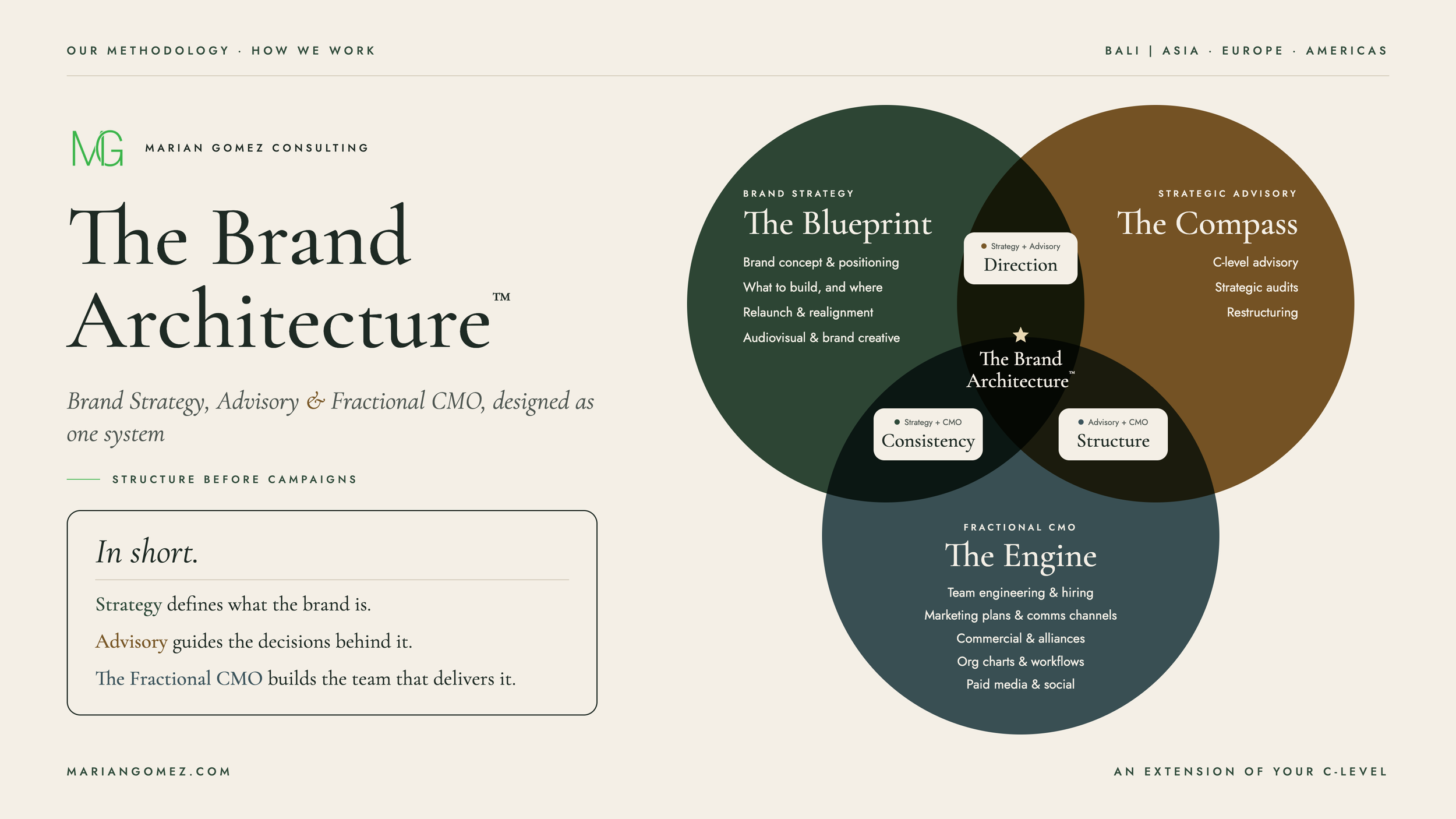
The Blueprint: Brand Strategy
What the brand is, and where it should live. Brand concept and positioning, what to build and in which market, relaunches and realignments when a brand has lost the thread, and the audiovisual and creative work that makes it visible. This is where we decide what you refuse to be, which is usually worth more than what you claim.
Usually nobody knows exactly what they need. They rarely do. But with our knowledge and conversations, we understand it from the first moment, from a humble and caring position. Sometimes it is a small tweak, sometimes the service or brand is not clear, sometimes they don’t know exactly who their target audience is, or where it is and how to attract it.
The Compass: Strategic Advisory
The decisions behind the brand. C-level advisory, strategic audits, restructuring. This is the seat at the table where an investor asks whether the longevity wing is a business or a brochure, and gets a straight answer.
This is probably one of the most delicate points. The conversation usually turns into a “professional vulnerable position”. Nobody loves to talk about needing help in some way, because sometimes it looks like a step back. But the reality is that everyone in the industry has it, and usually, the bigger the company, the more firms and consultants it has... to cover and support their teams. How you see the business, how to push, teaching about the industry, advising on the best moments, alliances, partnerships, PR movements... I am literally the shadow and the person at their back.
The Engine: Fractional CMO
The team that delivers it. Team engineering and hiring, marketing plans and communication channels, commercial strategy and alliances, org charts and workflows, paid media and social.
This is like a “messy room” where we accommodate with sense. Reusing things with a better purpose, giving the name and the sense to the room, removing the old and useless, and buying new things when it is necessary. It is a deep clean.
Strategy that nobody can execute is a very expensive PDF.
Where the value actually sits
The disciplines matter. The intersections matter more.
Strategy and Advisory together give you direction. Strategy and the CMO function give you consistency: the same brand on the website, in the sales deck, and at the reception desk. Advisory and the CMO function give you structure, an organization designed to execute instead of improvise.
Remove one circle and you can see exactly where it breaks. Positioning without an engine stays on the mood board. An engine without a compass runs fast in the wrong direction. Advice without a blueprint is just opinion.
Who it is built for
Founders building a hotel, retreat, or longevity concept who want the business designed before the logo. Family offices and holdings that need an asset worth going to, not just worth owning. Operators whose product is excellent and whose brand no longer says so.
We work from Bali with clients across Asia, Europe, and the Americas. Ibiza, Mallorca, Madrid, Southeast Asia. The geography changes. The fracture is almost always in the same place.
How a project starts
With a conversation. The proposal comes from understanding what is really happening, not only from what was asked.
Sometimes it is all three. Sometimes it is one circle and a very open conversation.
We do not replace your C-level. We act as an extension of it.
If you want to get in touch with us, you can do it through the contact section on our website, and we will organize a call. Not a sales call, not a consultancy session. A call to get to know each other, to see if there is space for a mutual conversation about collaborating, and then to send you an ad hoc proposal.
The form is brief, but it is there for a reason: to keep out bots and spammers, which is quite usual in the digital world. It keeps our time for the people who are actually in the industry. Or, if you prefer, you can contact me or my team directly on LinkedIn, through my personal profile, or on the Marian Gomez Consulting page.
For those who want to go further, there is now a Founding & Advisory Membership: an annual membership for continuous strategic guidance, with articles written only for members AND a monthly 50 minute 1:1 call. Places are limited, and not only in number. Each request is reviewed before a place is offered. When you apply, select “Founding & Advisory Membership” in the form.
I am Marian Gómez, Founder of Marian Gomez Consulting, a boutique strategic advisory with senior professionals for luxury hospitality, wellness, and tourism brands and holdings, based in Bali, advising clients across Asia, Europe, and the Americas. Our methodology, The Brand Architecture™, builds integrated brand ecosystems where brand, experience, operations, culture, narrative, and revenue function under one unified strategic vision.
I also write The Brand Architecture, my newsletter on Substack, for founders, investors, and leadership teams in luxury hospitality, tourism, wellness, and longevity. The same strategic thinking, with a slightly drier sense of humor and a little less polish. It is free, because I believe knowledge should be accessible.

It's Not Your Marketing. It's Your Internal Communication (And How Tri Hita Karana Explains It)
Tri Hita Karana, the Balinese model of well-being based on the balance between purpose, people, and nature, has become a sustainable hospitality strategy. But why do most implementations fail? The answer is not in marketing or certifications, but in Internal Communication. Lack of alignment dilutes purpose, mechanizes service, and reduces sustainability to good intentions. The true starting point is leadership that ensures the company's "why" is felt and lived daily.
Why the three pillars of sustainable hospitality fail at the same place: internal alignment.
Tri Hita Karana —'three causes of wellbeing' in Balinese— proposes that true prosperity arises from the balance between three fundamental relationships: with purpose, with people, and with nature. For your hospitality business, this isn't philosophy. It's strategy.
1. Purpose and Values (Parahyangan): The "Why"
I'm not talking about the mission statement hanging on the wall. It's the uncomfortable question: Why do we exist beyond generating profits? Businesses that connect with an authentic purpose —protecting an ecosystem, preserving a culinary tradition, revitalizing a community— create magnetic experiences - they can copy your posts, but not your essence. This is where your brand's soul resides.
2. Human Relationships (Pawongan): Your People, Your Asset
This includes employees, guests, suppliers, and crucially, the local community. Creating true partnerships. Hospitality stops being a service and becomes a genuine exchange. If you don't take care of your people, the guest will feel it. If your people aren't committed, so will they.
3. Harmony with Nature (Palemahan): Designing to Regenerate
This goes far beyond changing LED bulbs or reducing paper. It means designing operations that regenerate, not just minimize harm. Think about architecture that respects the environment or supply chains that turn sustainable local agriculture into a differentiator. I've been on projects where Zero Waste, so important for hotels with 200 rooms that generate daily amounts of food waste and garbage, betting on this means caring for the environment: people and nature in harmony.
On paper, this sounds logical. Even inspiring. But here's the problem: I know dozens of hotels and resorts that have these values printed in their mission statements, on their walls, even in their welcome dossiers. And still, they fail. Why? Because the three pillars don't collapse from lack of intention. They collapse from lack of alignment.
These three pillars always fail at the same place, and it's not a marketing problem.
When I arrive at a new consultancy, I dedicate 2 to 3 intense days conducting 1-on-1 interviews with each stakeholder. I ask them what they see, what frustrates them, but above all, what's the most valuable thing they know that nobody has asked them about. They have the best information about your business, but they're too busy putting out fires to use it. And there's problem number one: when you do a thousand things, you lose focus and what's important gets diluted.
When internal communication crumbles, everything else cascades down.
Purpose becomes an empty poster.
The relationship with guests becomes mechanical.
Sustainability initiatives remain good intentions.
Tri Hita Karana shows us that you can't have harmony with your guests or with the environment if harmony doesn't exist internally first. The three relationships are inseparably intertwined.
The True Starting Point: Leadership and Communication
If there's one thing I know with certainty after years in this business, it's: Communication, Communication, Communication. So, before thinking about the marketing campaign or the green certification, ask your leadership strategy:
Does your team know and feel the company's purpose?
A year ago I worked with a boutique hotel that had a beautiful purpose: 'Reconnect people with authentic local culture.' When I interviewed the chef, he told me that none of his team knew what that meant in their day-to-day. Zero. But when I asked them what was the most special thing about working there, the chef told me: 'Here I go to the market every morning and choose the fresh ingredients. Guests ask me what each thing is and I tell them the stories the vendors tell me.' That was the purpose. He was living it without knowing it. The problem wasn't the mission. It was that nobody had made the connection.
If your purpose only lives on the website, it doesn't exist.
The other questions that matter
Are there REAL communication channels where they feel heard, or just compliance meetings?
Do you celebrate and elevate those who shine so they serve as examples and inspire the rest?
And if someone isn't engaged: why? Sometimes you need the courage to let go of a rotten apple so the rest of the tree can flourish.
Real sustainability doesn't begin with a report. It begins with an honest conversation among your people.
So if any of this resonates, start here: this week, book 30 minutes with someone on your team you don't normally listen to. Not to solve anything. Just to ask: What's the most valuable thing you know that nobody has asked you?
You'll be surprised.
f you're running a hospitality business and this disconnect between mission and reality sounds familiar, that's exactly the gap I help bridge. I work with hotels, resorts, and wellness brands as their Chief Marketing Officer—building strategies that don't just look good on paper, they work because they're aligned from the inside out.
Want to talk about what that might look like for your business?
www.mariangomez.com