

The Brand Architecture: Connecting All the Dots
Fragmented marketing, siloed departments, and piecemeal agency work destroy luxury brand equity. In this insight, luxury hospitality strategist Marian Gómez explores why luxury assets fail when built in parts—and how The Brand Architecture™ method connects brand strategy, team engineering, and commercial operations under one unified vision for hotels, wellness resorts, and longevity holdings.
Photo credit: Georges Seurat, Circus Sideshow (Parade de cirque), 1887/88, The Metropolitan Museum of Art. Thousands of dots that only make sense together, under one eye. The “parade” was the small free show held at the circus entrance to attract the audience to buy a ticket. It is the shop window, not the performance. Like brands, which are not only a facade.
A branding agency delivered the identity. A consultant delivered the strategy deck. A marketing hire delivered the campaigns. Each piece is competent. None of them talk to each other.
It is a patchwork. It looks good, I will not deny it. But the reality is a collection of good actions, not a Goya, a Velázquez or a Picasso painted with one objective, one perspective, and one line set by a single conductor. What it produces is disconnection: layers stacked on top of each other instead of one piece in tune. I have nothing against patchwork. You get the point.
That is not bad luck. That is what happens when a brand is bought in parts.
After two decades inside the biggest conglomerates in the hospitality industry, the most renowned tourism holdings and wellness brands, I have seen the whole picture from the inside, and I still see it today. Most of the companies do not operate as one company. Each area works as its own isolated company, sharing “things”.
I never believed in this way. In very short words for a complex thing, my work is perspective, and how I work is connecting all the dots. I was already doing it as an intern, twenty years ago. In industry jargon, it is my “intellectual property”, my professional/personal brand, and everyone has their own. I believe each one should offer what they feel is their “watermark”.
Basically, when someone asks for something in particular, it is complicated to explain why these actions and this strategy and no other, because the whole spectrum I need to contemplate is impossible to explain in a board meeting. We try, in simple words, with some simple information, but in blunt terms, at this point the most relevant thing is who is receiving the information, how open minded they are, and whether the founder, the investor, or the CEO (not a Chief Everything Officer keeping their hands in every single small and insignificant detail) is open to it.
I always remember, and I mentioned it in one of my very first articles on this blog, Insights, when one of the Global Directors brought up in an ExCom meeting including a small, tiny advertisement in a newspaper in Canada, with no sense other than a romantic and nostalgic approach. I really respect them as a professional, but I still almost black out every time it jumps into my mind.
What The Brand Architecture™ is
The Brand Architecture™ is the strategic methodology of Marian Gomez Consulting. It integrates three disciplines into one system for luxury hospitality, tourism, wellness, and longevity brands: Brand Strategy, Strategic Advisory, and the Fractional CMO. Each one solves a specific problem. Together, they let a brand hold its value beyond the next campaign.
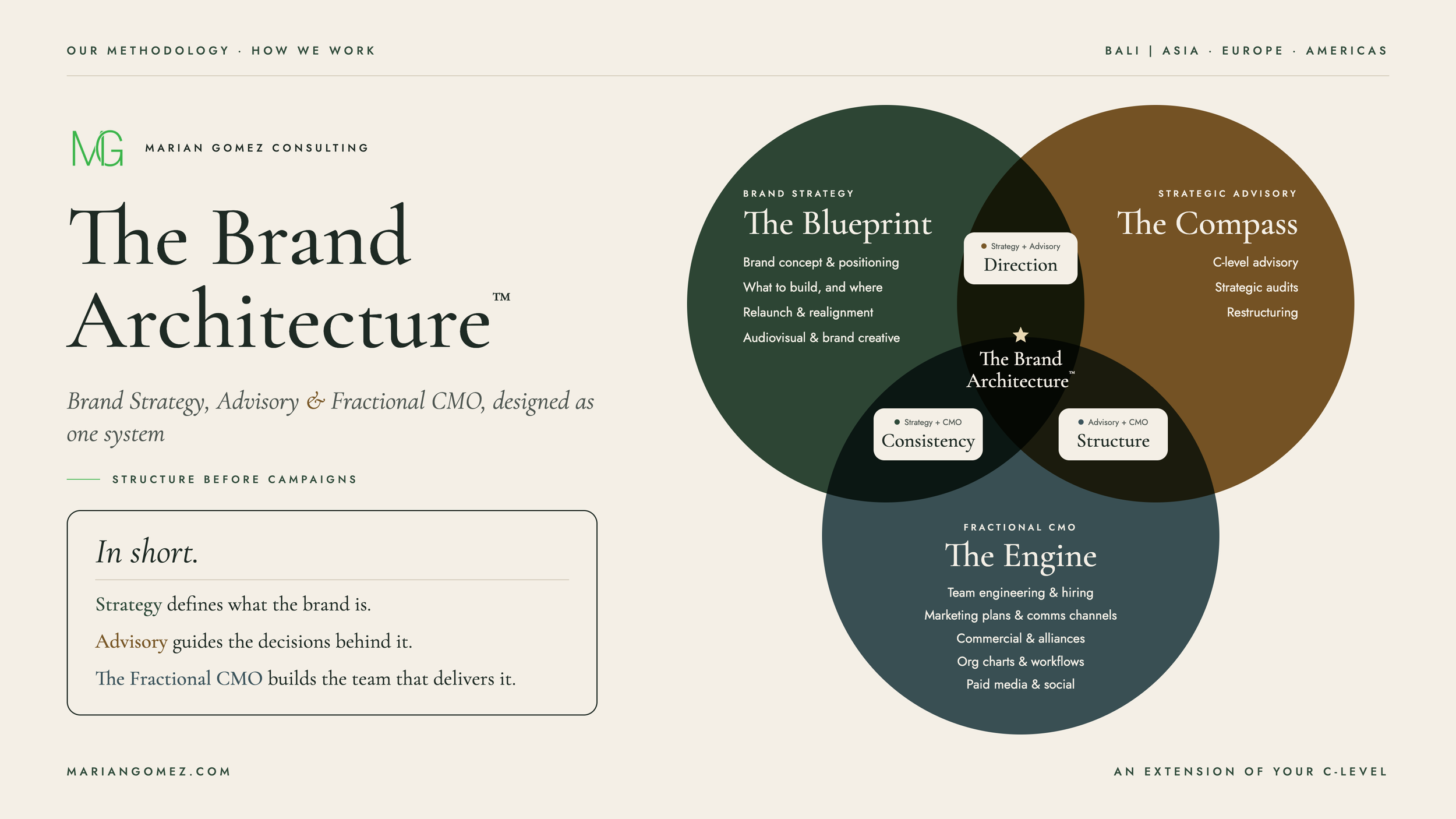
The Blueprint: Brand Strategy
What the brand is, and where it should live. Brand concept and positioning, what to build and in which market, relaunches and realignments when a brand has lost the thread, and the audiovisual and creative work that makes it visible. This is where we decide what you refuse to be, which is usually worth more than what you claim.
Usually nobody knows exactly what they need. They rarely do. But with our knowledge and conversations, we understand it from the first moment, from a humble and caring position. Sometimes it is a small tweak, sometimes the service or brand is not clear, sometimes they don’t know exactly who their target audience is, or where it is and how to attract it.
The Compass: Strategic Advisory
The decisions behind the brand. C-level advisory, strategic audits, restructuring. This is the seat at the table where an investor asks whether the longevity wing is a business or a brochure, and gets a straight answer.
This is probably one of the most delicate points. The conversation usually turns into a “professional vulnerable position”. Nobody loves to talk about needing help in some way, because sometimes it looks like a step back. But the reality is that everyone in the industry has it, and usually, the bigger the company, the more firms and consultants it has... to cover and support their teams. How you see the business, how to push, teaching about the industry, advising on the best moments, alliances, partnerships, PR movements... I am literally the shadow and the person at their back.
The Engine: Fractional CMO
The team that delivers it. Team engineering and hiring, marketing plans and communication channels, commercial strategy and alliances, org charts and workflows, paid media and social.
This is like a “messy room” where we accommodate with sense. Reusing things with a better purpose, giving the name and the sense to the room, removing the old and useless, and buying new things when it is necessary. It is a deep clean.
Strategy that nobody can execute is a very expensive PDF.
Where the value actually sits
The disciplines matter. The intersections matter more.
Strategy and Advisory together give you direction. Strategy and the CMO function give you consistency: the same brand on the website, in the sales deck, and at the reception desk. Advisory and the CMO function give you structure, an organization designed to execute instead of improvise.
Remove one circle and you can see exactly where it breaks. Positioning without an engine stays on the mood board. An engine without a compass runs fast in the wrong direction. Advice without a blueprint is just opinion.
Who it is built for
Founders building a hotel, retreat, or longevity concept who want the business designed before the logo. Family offices and holdings that need an asset worth going to, not just worth owning. Operators whose product is excellent and whose brand no longer says so.
We work from Bali with clients across Asia, Europe, and the Americas. Ibiza, Mallorca, Madrid, Southeast Asia. The geography changes. The fracture is almost always in the same place.
How a project starts
With a conversation. The proposal comes from understanding what is really happening, not only from what was asked.
Sometimes it is all three. Sometimes it is one circle and a very open conversation.
We do not replace your C-level. We act as an extension of it.
If you want to get in touch with us, you can do it through the contact section on our website, and we will organize a call. Not a sales call, not a consultancy session. A call to get to know each other, to see if there is space for a mutual conversation about collaborating, and then to send you an ad hoc proposal.
The form is brief, but it is there for a reason: to keep out bots and spammers, which is quite usual in the digital world. It keeps our time for the people who are actually in the industry. Or, if you prefer, you can contact me or my team directly on LinkedIn, through my personal profile, or on the Marian Gomez Consulting page.
For those who want to go further, there is now a Founding & Advisory Membership: an annual membership for continuous strategic guidance, with articles written only for members AND a monthly 50 minute 1:1 call. Places are limited, and not only in number. Each request is reviewed before a place is offered. When you apply, select “Founding & Advisory Membership” in the form.
I am Marian Gómez, Founder of Marian Gomez Consulting, a boutique strategic advisory with senior professionals for luxury hospitality, wellness, and tourism brands and holdings, based in Bali, advising clients across Asia, Europe, and the Americas. Our methodology, The Brand Architecture™, builds integrated brand ecosystems where brand, experience, operations, culture, narrative, and revenue function under one unified strategic vision.
I also write The Brand Architecture, my newsletter on Substack, for founders, investors, and leadership teams in luxury hospitality, tourism, wellness, and longevity. The same strategic thinking, with a slightly drier sense of humor and a little less polish. It is free, because I believe knowledge should be accessible.

The Mandatory Line Every Pre-Opening Budget Needs to Include
Operating globally from Bali for investment holdings across Europe, the Americas, and Asia-Pacific, we define brand equity as an operational system, not a visual aesthetic. Discover how strategic positioning, DNA architecture, and portfolio alignment drive yield, elevate asset valuation, and secure long-term market dominance for high-value hospitality, luxury wellness, and longevity assets worldwide.
Why luxury hotels, wellness resorts, and longevity centers that start marketing 90 days before opening keep paying for it long after the ribbon is cut.
Every hotel development budget includes a line for furniture, décor, fixtures, and equipment. Nearly all account for licenses, permits, and operator fees. Very few have a line that says "build the demand engine."
When strategy does appear, it is usually treated as an operating expense and left for last, once the capital has already been committed to everything else. It should work the other way around. The demand engine needs to be built in parallel with the building itself, from the day the first block is laid on site.
This is where hospitality parts ways with real estate. When you sell apartments, villas, or the building itself, the work is largely done once construction is finished. In hospitality, that is the moment the real business begins. Rooms, experiences, and wellness and longevity treatments are sold night after night, and every one of them depends on service and operation. Without marketing and sales before, during, and after opening, what remains is a building with an expensive operation. Or a Truman Show: a flawless set where the staff performs every day for an audience that never arrives.
Years ago, a friend told me he had built a boutique hotel, but guests were not coming. I asked what marketing or sales actions they had put in place. None. Not a single one. I told him that, in that case, he was not a hotelier. He was a builder.
That omission is one of the most expensive decisions in hospitality and tourism. It rarely shows up as a single dramatic loss. It bleeds out quietly, month after month, starting the day the doors open.
How pre-opening budgets are actually built
Most pre-opening capital goes to what can be touched and inspected: construction, interiors, technology, licenses, and the operational team. What remains, often a thin slice, goes to "marketing," scheduled somewhere between 60 and 90 days before opening. By then the brand is an afterthought, the website is a template, the photography is rushed, and the go-to-market plan amounts to a launch announcement and a discount.
Around that 90 day mark, the owner usually hires a marketing director, sometimes a small junior team. However talented they are, they are expected to design the overall strategy, plan the launch, and build the commercial team at the same time, while the operation is also getting ready to open. No single hire can carry that load. The foundations are the first thing to fail, and it is rarely the fault of the person in the role.
This is precisely the phase where we step in. From the outside, we design the structure and leave it ready before the team arrives: the launch strategy, and the setup of the marketing, sales, reservations, and guest services teams that will run it.
What is pre-opening marketing, really?
Pre-opening marketing is the work of building positioning, direct demand, and distribution strategy before a hotel or wellness property opens, so it reaches stabilized occupancy without depending on discounts or intermediaries. In financial terms, brand architecture, positioning, and go-to-market strategy are not promotional expenses. They are preventive controls on future operating costs.
Consider what happens when they are missing.
The property opens with an empty book. With no audience built before day one, there is no direct demand waiting. Inventory sits unsold while payroll, utilities, and debt service run at full speed.
Occupancy gets outsourced to OTAs. Online travel agencies deliver volume when rooms need filling fast, but their commission comes straight out of margin, and they place someone else between the property and its guest.
Positioning gets bought with discounts. Without a clear identity, price becomes the only lever. Early discounting anchors how the market reads your rate, and that anchor is very hard to lift. For a luxury or longevity property, one season of this can undo what the design and the program were built to justify.
Cash burns on work done in a hurry. Rushed creative, reactive media spend, and agency fees at emergency rates cost far more than the same work done in a planned sequence.
Each of these lands in OpEx. Most could have been avoided by bringing strategy into the CapEx conversation.
When should a luxury hotel start marketing before opening?
A property does not start competing on opening day. It starts competing the moment it becomes visible, and today that happens whether it is planned or not: a rendering on Instagram, a mention in a trade newsletter, an answer in ChatGPT or Google AI Mode.
Openings that ramp up well tend to share a pattern. Awareness, a clear point of view, and demand waiting before the ribbon is cut. The others spend their first months in a scramble. The difference is rarely budget. It is timing and sequence.
In the openings that perform, the brand already knows who it is for and why it is different nine to twelve months before the doors open. Demand is already flowing through its own channels, and the relationship with OTAs is a decision rather than a dependency. In the ones that struggle, all of this is still being worked out in the final weeks, often by a team that has just been hired, with the rates already loaded and the pressure to fill rooms already on the table. By then, the problem is no longer marketing. It is structure.
For wellness and longevity centers, the gap is even wider. Their guests commit to programs of several days or weeks, often deciding months in advance and only after trust has been built. A center that arrives late to the market has usually lost its first season before it opens.
Why mid-sized hotel groups carry more risk than global brands
The cost of this trap is not evenly distributed. A multinational opens with an advantage from the start: a corporate team, years of guest data, loyalty programs, and a reputation that often reaches its followers before the announcement is even finished. Even so, the strongest global operators plan, sequence, and resource every opening, because the cushion is only as good as the strategy that activates it.
A mid-sized hotel holding, an independent wellness resort, or a longevity center run by its founder has no such cushion. No legacy audience, no loyalty base, often no dedicated team to absorb the workload. Reputation, database, and channels have to be built from zero while the new operation gets ready to open, and often while the same people keep running the other brands, assets, or businesses in the portfolio.
For these groups, organization and planning are the substitute for scale. A multinational borrows momentum from its size. A holding has to create it, and what is usually missing is not will or talent but the structure behind them. Nobody clearly owns the timeline, the brand is promoted before it is articulated, and the go-to-market conversation begins once the building is finished instead of while it is still under construction.
It is entirely achievable. It simply cannot be improvised 90 days out. Nobody finishes an Ironman by starting to train a few weeks before the race, however committed they are. An opening follows the same logic.
The question to bring to your next budget review
What is our plan to reach stabilized occupancy? If the answer is vague, the risk is not managed. It is just invisible.
Strategic marketing before opening is not about looking good on launch day. It protects the capital already invested in the asset. Planning is the one competitive advantage that can be built in advance.
Our team brings European, Asian, and American perspectives to twenty years of work in hospitality, tourism, wellness, and longevity, with founders, owners, developers, and investment groups across all three regions. If you have a project in pre-opening or repositioning, let's talk through your timeline and demand plan.
I am Marian Gómez, a Madrid-born strategist and the Founder of Marian Gomez Consulting, a boutique strategic advisory for luxury hospitality, wellness, and tourism brands and holdings, based in Bali, advising clients across Asia, Europe, and the Americas. I publish around the 15th of each month in this blog, sometimes a few days earlier, sometimes later, and occasionally outside that cadence when something worth saying surfaces in the industry. What you will find here leans more didactic and deliberately deep: not written for general consumption, but for those who operate at the level where these distinctions matter.
For more applied, day-to-day thinking and a slightly sharper sense of humor, find me on Substack at The Brand Architecture, a publication written for founders, investors, and leadership teams in luxury hospitality, with a strategic lens on wellness, travel, tourism, and longevity. Not about ideas, but about two decades of expertise in brand and marketing strategy across luxury hospitality, tourism, and wellness.

Consuming Content Does Not Give You Judgment
Consuming content is not the same as having judgment. Watching videos about a subject does not make you an expert in it, and knowing the vocabulary of a discipline does not mean you know how to navigate it when conditions change.
Watching TikTok videos will not earn you a university degree. Reading articles will not either. Consuming content constantly does not equate to having experience in a subject to which a professional has dedicated years of study, practice, and work. It can give you vocabulary, references, ideas, and it can even open a door.
But it does not automatically give you judgment. No.
The Fifteen-Second University
Jefferson Reed is the protagonist of The Meteor Man, a 1993 film directed by Robert Townsend. By placing his hand over a book, he absorbed everything in it within seconds. But that remains science fiction.
That is not going to happen to you. At least, not yet. And AI is not going to give you knowledge, judgment, and experience either.
That is not to dismiss these tools. You simply need to know what to use them for and how to use them.
We live in a fascinating time. We have fast information from different sources. And yet, we are losing the habit of checking sources, verifying accuracy, comparing information, and, above all, exercising judgment. I would venture to say that, in addition, we are going through a transition. In several European countries, a return to physical books, paper, and pen is already taking place in schools, though that is another conversation.
A person can watch three videos about positioning, read two articles about artificial intelligence, and listen to a podcast about growth before breakfast. By nine in the morning, they already feel they understand marketing. By noon, the problem arrives when it is time to decide. Knowing the concepts does not mean knowing how to apply them. Knowing what a strategy is does not mean knowing how to build one. Repeating words like brand awareness, customer journey, wellness, longevity, community, or revenue does not mean understanding how they function inside a company.
You can know the name of a tool and not know when to use it. You can know what a metric does and not understand what it is indicating, and you can have read twenty articles about positioning and still not know why a brand fails to be perceived the way it wants.
Exposure to information can create a sense of familiarity. And familiarity, when mistaken for understanding, can produce a rather dangerous illusion.
The Illusion of Knowing
I remember a dinner with a friend where we talked about marketing and business strategy, and about the importance of working with data. One idea stuck with him: he needed data.
Some time later, I arrived at his office and he introduced me to a new hire. I asked what her role was.
"I record data," she answered.
How nice, I thought, hastily. The nuance comes later, as a well-known Spanish song puts it. They had recorded the data, but not the purpose. Having data does not turn a company into a data driven company. An organization can accumulate reports, spreadsheets, metrics, and dashboards, and still make decisions based on instinct, imitation, panic, or, wilder still, all three at once.
Recording is not analyzing, and analyzing is not understanding.
The Enthusiast
Let us imagine Marian. I will use my own name so no one feels singled out, except for the Marians of the world.
Marian has watched many videos about sailing. She knows sails exist, and the rudder, the currents, the wind, and the storms. She has listened to sailors explain how a boat is prepared.
But she does not know what a navigation chart is. She has seen something about them on YouTube, but she does not know how to plot one. She has never plotted one either, although she understands the concept. The GPS looks to her like a collection of little lights and numbers without a trending soundtrack behind them. She does not know how to read it, interpret it, or use it to decide a course. Until now, she had not needed to: she had always sailed in a straight line across the turquoise waters of Bali.
She is convinced she knows how to sail. So she boards a boat. The sea is calm. The sky is clear. The wind blows gently. Life smiles on her. She looks at the horizon and thinks all of it was simpler than it seemed.
Until the winds change, a storm rolls in, lightning strikes, and a current pulls her off course.
Knowing the vocabulary of the sea does not equate to knowing how to steer a boat. Nor does knowing how to identify a storm mean knowing how to get through it.
When the Winds Change
In marketing and in business, everything seems simple as long as conditions are favorable, or when the situation is so disastrous that any move looks like an improvement. That, one could say, is disastrously amusing, though less so for the business owner.
It cannot get any worse. And they find out it can.
When the boat has not sunk, but it is no longer sailing well either.
When the brand still holds value, but begins to lose clarity.
When sales still come in, although it becomes harder and harder to explain why.
When the market has not disappeared, but no longer forgives improvisation.
This is when it becomes clear who knew how to sail and who had only watched videos about sailing. The professional who knows a subject does not simply act once the problem is already in front of them. They know how to read conditions before setting sail, what resources they have on board, what risks they can take, when to move forward, when to wait, and when to change course.
And, above all, they know that not every problem is solved with the same maneuver. Do you remember Captain Sully? He made an emergency landing on the Hudson River. It was not luck. It was experience.
Bailing Water Is Not Sailing
In marketing, many companies wait until the boat is full of water before they start moving. Then the urgent meeting arrives.
"We need to do something."
"We need to launch a campaign."
"We need more visibility."
"The sales team is not converting."
"We need to ramp up social media."
"We need to start publishing content."
And, of course, everything has to happen immediately.
But bailing water out of the boat is not the same as knowing where it is coming in. A quick action can relieve the pressure for a few days. It can even create the sense that the company is responding. Spoiler: if no one identifies the source of the problem, the water will keep coming in.
A company cannot turn improvisation into its operating model. Strategy does not consist of making more moves. It consists of knowing which move to make, at what moment, and in what way. With agility, yes. But also with protection.
Speed Requires Judgment
There is an idea worth revisiting: that experience makes people slow.
Experience can make you faster because it lets you distinguish the urgent from the important. Recognize patterns. Anticipate consequences. Identify what information is missing. Know which decisions are reversible and which can compromise a brand for years.
Experience does not make you slow. It lets you move fast without moving blindly.
Those without judgment tend to confuse speed with agility. Speed means doing something quickly. Agility means moving quickly without losing the ability to correct course, protect what matters, and make decisions. They are not the same.
Not Everything That Can Be Copied Should Be Copied
Digital content can be an extraordinary tool for learning. It can bring you closer to professionals who once felt distant. It can help you discover a discipline, a methodology, or a different way of thinking.
The problem is not watching videos. It is believing that watching videos equates to having lived the problems those professionals are describing. Listening to someone talk about a crisis is not the same as having had to make decisions during one. Reading about a hotel opening in Ibiza is not the same as having managed the months when the operation was not ready. Knowing a metric is not the same as having had to explain its consequences to an investor. And, above all, talking about positioning is not the same as deciding what you are willing to sacrifice so a brand can occupy a clear space in the customer's mind.
Information can point you toward the path, but it cannot walk it for you.
A Degree Does Not Sail for You Either
A clarification is necessary here. A university degree, on its own, does not turn anyone into an expert either. There are people with degrees and no judgment, and extraordinary professionals who built their knowledge outside university. Formal education is not an absolute guarantee. But it is not decorative either.
A solid education forces you to study a subject in a structured way, understand its foundations, engage with different perspectives, and demonstrate that you can work with concepts beyond the surface. Then comes practice, along with the mistakes, decisions, consequences, and responsibility.
Learning does not appear in a thirty second video, because it does not fit in thirty seconds. It is not born from a single source. It is built with education, practice, experience, reflection, and exposure to real problems, and here is the uncomfortable question almost no one asks in time. It is not whether the team knows how to recognize a current when they see one. It is what sinks first when no one on board had detected that the current had been changing direction for three months.
Distinguishing between knowing and believing you know, and building the judgment that lies between the two, is precisely the work I do with the brands and teams I work with, through Strategic Architecture™.
I am Marian Gómez, the Founder of Marian Gomez Consulting, a boutique strategic advisory for luxury hospitality, wellness, and tourism brands and holdings, based in Bali, advising clients across Asia, Europe, and the Americas. I publish around the 15th of each month in this blog, sometimes a few days earlier, sometimes later, and occasionally outside that cadence when something worth saying surfaces in the industry. What you will find here leans more didactic and deliberately deep: not written for general consumption, but for those who operate at the level where these distinctions matter. For more applied, day-to-day thinking and a slightly sharper sense of humor, find me at The Brand Architecture, a publication written for founders, investors, and leadership teams in luxury hospitality, with a strategic lens on wellness, travel, tourism, and longevity. Not about ideas, but about two decades of expertise in brand and marketing strategy across luxury hospitality, tourism, and wellness.

Brand Expansion Roadmap: A Strategic Path for Growth in Luxury Hospitality, Tourism, and Lifestyle
Growth in luxury hospitality and lifestyle demands a strategic roadmap, not just incremental bookings. A well-crafted Brand Expansion Roadmap identifies new geographic markets, service extensions, or adjacent segments that reinforce core identity while diversifying revenue. It's the essential framework for a CMO to expand your brand and protect exclusivity.
Beyond Incremental Growth: The Vision for Expansion
Growth in luxury hospitality and lifestyle is not just about securing a few more bookings or increasing short-term revenue. True expansion requires a deliberate, strategic roadmap that identifies new geographic markets, innovative service extensions, or adjacent segments that align authentically with the brand’s core.
A well-crafted Brand Expansion Roadmap allows brands to diversify revenue streams while reinforcing their core identity and values — protecting exclusivity even as they multiply touchpoints. This balance is vital in luxury markets where brand dilution poses a real risk when expansion is poorly planned or executed.
Defining the Right Opportunities
The journey of brand expansion begins with a deep understanding of both the brand’s essence and the evolving lifestyle preferences and expectations of its target clientele. This includes assessing:
Emerging luxury destinations or underdeveloped markets with growing affluent populations seeking bespoke experiences.
New product or service offerings that complement existing portfolio elements and elevate the brand promise.
Adjacent categories where the brand’s identity and operational strengths can translate into competitive advantages.
For example, a luxury resort might explore branded private residences or curated wellness retreats as natural extensions. Each must be evaluated for authentic fit, market demand, and synergies with the existing brand ecosystem.
Sequencing and Timing for Sustainable Growth
A strategic roadmap sequences expansions to optimize market impact and operational excellence. Prioritizing initiatives based on rigorous market analysis, competitor benchmarks, and internal capabilities ensures that growth is measured and scalable.
Early wins should consolidate brand authority in key segments, building momentum and financial capacity for future, potentially riskier, expansions. This staggered approach safeguards brand reputation and ensures consistent customer experience standards.
Preserving Brand Integrity and Exclusivity
Expansion in luxury demands uncompromising attention to detail and quality. Every new market entry or product line must embody the brand’s distinctiveness and exclusivity.
This requires maintaining stringent controls over partner selection, service delivery, and communications, so that every touchpoint reflects the brand’s prestige. A Brand Expansion Roadmap is also a framework for governance, helping teams align on strategic intent and execution rigor.
Leadership Perspective: Orchestrating Growth with Strategic Foresight
From the vantage point of a CMO specialized in luxury hospitality and lifestyle, the Brand Expansion Roadmap is a dynamic tool that integrates market opportunities with brand stewardship. It demands both visionary foresight and tactical discipline, continuously calibrated against evolving market trends and consumer behaviors.
This roadmap empowers leadership teams to expand with confidence, transforming the brand from a luxury destination or service into a diversified lifestyle ecosystem with enduring appeal, resilience, and profitability.
This article is part 4 of my 5-part methodology series outlining how leading luxury brands architect sustainable growth. To revisit the foundational steps, explore:
Step 2: Media Portfolio Architecture
Step 3: Ecosystem Partnership Strategy
For brands seeking strategic marketing leadership, I offer Chief Marketing Officer (CMO) services that design and lead adaptive growth ecosystems tailored to luxury hospitality, tourism, and lifestyle businesses. Discover more at: CMO Services | Marian Gomez Consulting.
A strategic Chief Marketing Officer (CMO) designs and leads growth ecosystems, continuously adapting strategy to market dynamics and business goals. For luxury hospitality, tourism, and lifestyle brands, this leadership is essential to rise above the noise and build long-term value.
For deeper insights and practical case studies on transforming your marketing strategy, explore my blog with advanced hospitality and tourism marketing approaches:
Explore Hospitality & Tourism Marketing Strategies
This is part 4 of my 5-part methodology series. Next week, don’t miss the final installment: 5. Revenue Strategy from Marketing, where we link marketing initiatives directly to financial performance metrics to optimize profitability.

Why Your Luxury Hotel Is Competing on Price (And Losing): The Framework That Changes Everything
Discover why competing on price is losing the luxury hotel market and learn a unique emotional positioning framework to command premium rates and stand out with unforgettable guest experiences.
Most luxury hotels think they're competing against other hotels. Wrong.
You're competing for emotional territory in your guest's mind, and most properties are fighting over the same cramped space while vast territories remain unclaimed.
The Common Marketing Mistake in Luxury Hotels
Walk into any luxury hotel marketing meeting, and you'll hear the same conversation:
"Our competitors dropped rates 15%."
"We have to match them or lose bookings."
"Let's push the spa and restaurant more."
If you're competing on price, you've already lost the positioning war.
After working with luxury hospitality brands across three continents, I've seen this pattern repeatedly: hotels with identical amenities, similar service levels, and comparable locations, yet one commands 40% higher rates with 85% occupancy while the other struggles to fill rooms. The difference? Strategic positioning.
The Competitive Positioning Framework: Four Steps to Premium Pricing Power
Step 1: Map the Emotional Landscape, Not Just the Physical
Most hotels map their competition geographically. Fatal mistake.
Your real competitors aren't the hotels within a 5-mile radius; they're any brand competing for the same emotional need your guest seeks to fulfill.
What does your guest truly seek beyond a bed?
Status and social currency?
Complete escape and transformation?
Deep cultural immersion?
Spiritual renewal?
Creative inspiration?
Business power positioning?
Study the masters:
Four Seasons owns "flawless service anticipation"
Aman owns "spiritual sanctuary"
One&Only owns "rare hideaway experiences"
Capella owns "curated cultural immersion"
Notice something? None of these brands compete on thread count or marble thickness. They've claimed distinct emotional territories.
The exercise: Create a positioning map plotting competitors on key emotional drivers. Where are the white spaces?
Step 2: Discover Your Irreplicable "Reason Why"
Every luxury brand needs an unassailable "reason why" they can deliver their emotional promise better than anyone else.
This isn't about what you do; it's about why you're uniquely qualified to do it.
Location alone isn't enough. Everyone has a view, a beach, or historic charm. The real differentiators:
Unreplicable heritage: The Gritti Palace's 500-year history as a Doge's residence
Founder philosophy: Aman's Adrian Zecha vision of creating sanctuaries, not hotels
Exclusive access: Necker Island's private island status
Proprietary methodology: COMO's wellness expertise from decades of innovation
Cultural authenticity: A ryokan family's 15-generation hospitality tradition
The test: Could a competitor with an unlimited budget replicate your "reason why" in five years? If yes, it's not defensible enough.
Step 3: Explore Untapped Emotional White Space
Most hotels cluster around the same 3-4 attributes: service, location, amenities, and design. They're fighting a battle for the same overcrowded territory.
Meanwhile, entire emotional landscapes remain unoccupied.
Untapped territories I've identified:
Intellectual stimulation: Hotels that make guests smarter (beyond basic cultural tours)
Creative catalyst: Spaces designed to unlock artistic inspiration
Wellness innovation: Beyond spa, hotels that genuinely transform health
Business amplification: Environments that enhance professional performance
Sustainable luxury: Guilt-free indulgence that makes a positive impact
Intergenerational bonding: Experiences that create lasting family connections
The opportunity: While competitors fight over "best service" and "stunning views," smart brands are claiming entirely new emotional territories.
Step 4: Build Your Defensive Moat
What some luxury hotels get wrong: They think good service and beautiful architecture are differentiators.
They're not. They're table stakes.
In luxury hospitality, impeccable service and stunning design aren't value-adds; they're minimum entry requirements. If you don't have them, you're simply not in the game. But having them doesn't win you the game either.
Similarly, running a Google Ads or Meta campaign is an important marketing action, but it is not your strategy. Without a clearly defined strategy, one that establishes your core values, emotional positioning, and unique promise, such campaigns are just noise. True market leadership comes from a well-crafted strategy that guides every marketing action toward a coherent and authentic brand experience.
The real moat lives in the experiential details:
HOW you deliver (not just what you deliver)
WHAT you anticipate (not just what you react to)
HOW you communicate (not just what you say)
It's not what you claim to offer; it's what guests feel you transmit.
Examples of real defensive moats:
Exclusive partnerships that create unique access
Proprietary rituals that guests expect only at your property
Signature experiences that become part of your brand DNA
Cultural connections that can't be replicated
The deeper the experiential moat, the higher the rates you can command.
The Real Result: Price Comparison Becomes Irrelevant
When you nail competitive positioning, something magical happens: price comparison becomes irrelevant.
Your guests don't evaluate you against competitors because competitors can't deliver your unique emotional promise. They either want YOU, or they settle for something else. Rate wars end. Premium pricing begins.
Case Study: How One Resort Increased ADR by 60%
A Caribbean resort I worked with was stuck competing with five similar properties on the same island. Same luxury level, same pristine beaches, same high-end amenities.
The problem: Generic "paradise" positioning led to constant rate pressure.
The solution: We discovered their unique "reason "why," the resort's marine biologist founder had created the region's most successful coral restoration program.
The new positioning: "Conservation luxury," where your stay directly contributes to healing the ocean.
The result:
ADR increased 60% within 18 months
Occupancy rose to 92% (from 67%)
Guest satisfaction scores reached all-time highs
Zero rate pressure from competitors (who couldn't replicate the conservation story)
Your Next Strategic Move
Stop competing on features everyone has. Start competing on emotional territory only you can own.
Ask yourself:
What emotional need do my best guests really come to fulfill?
What's my unassailable "reason why" I can deliver this better than anyone?
What competitive white space can I claim and defend?
What experiential details make my guests feel something they can't get elsewhere?
Remember: In luxury, guests don't buy hotels. They buy transformations, experiences, and feelings.
The question isn't whether you have marble bathrooms and Egyptian cotton sheets; everyone in luxury does.
This is stage 1 of my 5-part strategic methodology series that transforms marketing from a cost center to a profit driver. While I typically share articles on the 1st and 15th of each month, I'll be releasing each stage of this framework weekly over the next four weeks. Next week: Media Portfolio Architecture, how to allocate budget by customer journey moment, not just by channel. Want the complete framework overview? Link to the complete framework
_________________________________________
A strategic Chief Marketing Officer (CMO) designs and leads a growth ecosystem, continuously adapting strategy to market dynamics and business goals. For brands in luxury hospitality, tourism, and wellness, this leadership is essential to rise above the noise and build long-term value.
Marian Gomez Consulting
Fractional Chief Marketing Officer & Strategy Consultant
Boutique Strategy Agency | Hospitality, Tourism & Wellness Industry
www.mariangomez.com

Quiet Luxury in Hospitality: How Four Seasons, Dior, and Aman Set the Standard for Authentic Experiences
Explore the shift to quiet luxury in hospitality through case studies of Four Seasons, Dior, and Aman. A CMO's perspective on how authentic partnerships, subtle experiences, and deep client relationships are defining the future of luxury brand strategy. Marian Gomez Consulting - CMO & Strategy Consuttant - Boutique Agency.
As summer invites us to slow down and savor life's finer moments, the luxury hospitality industry finds itself at a fascinating crossroads. The once-dominant trend of loud, logo-heavy brand collaborations is giving way to a more refined, subtle expression of luxury—one that resonates deeply with today's discerning clientele and represents a fundamental shift in how authentic luxury experiences are created and delivered.
The Evolution of Luxury in Hospitality: From Ostentatious to Discreet
The luxury hospitality market has undergone a profound transformation in recent years. What once defined luxury—ostentatious displays, prominent logos, and flashy collaborations—no longer resonates with today's sophisticated travelers. The market has decisively moved toward quiet luxury, a refined, understated elegance favored by "old money" sensibilities and discerning consumers who inherently understand what true luxury means.
This shift reflects a deeper change in consumer behavior and values. Modern luxury travelers don't need a billboard on the hotel façade to confirm quality; they feel it in the seamless service, the thoughtful details, and the meaningful experiences. They seek authenticity over visibility, substance over spectacle, and lasting value over momentary impressions.
Case Studies in Successful Brand Partnerships in Luxury Hospitality
The Four Seasons and Dior Collaboration: A Masterclass in Authenticity and Sophistication
From my perspective as a CMO in the industry, the landmark partnership between Four Seasons Resort The Nam Hai and Dior represents a masterstroke in luxury brand collaboration. This partnership succeeded because the brands' clientele and values were perfectly aligned, creating an authentic foundation for meaningful engagement.
Importantly, the collaboration was launched with the clear purpose of promoting Dior's popular summer canvas bag, the Dior Book Tote, as part of Dior's Dioriviera summer capsule collection. This strategic move married fashion and hospitality in an authentic way, creating an immersive, elegant experience that felt seamless rather than forced.
The partnership wasn't just about slapping a designer label on a hotel; it was about crafting a world where Dior's timeless sophistication met Four Seasons' legendary service, a "Diorized" realm of understated opulence. From Dior mosaics in the pools to exclusive pop-up boutiques and sensory workshops, every detail was thoughtfully curated to elevate the guest experience without overwhelming it. The Dior Book Tote and other summer pieces were integrated naturally into this environment, inviting guests to live the brand's lifestyle during their stay.
Aman Hotels and Their Wellness-Focused Approach with Novak Djokovic
Aman Hotels exemplifies the quiet luxury approach through their strategic partnership with tennis legend Novak Djokovic as Global Wellness Advisor. Rather than focusing on branding overload, Aman invests in what their clientele truly values; privacy, wellness, and curated experiences.
Djokovic has co-created a Detoxification Programme available at seven Aman properties worldwide, an immersive, holistic wellness journey blending physical, mental, and spiritual renewal. This partnership is less about logos and more about lasting value and authentic engagement.
This collaboration reflects Aman's commitment to quiet luxury: offering exposure through meaningful experiences rather than loud branding. It's a reminder that luxury hospitality today is about listening to your clientele, anticipating their desires, and delivering subtle yet profound moments of excellence.
Strategic Marketing Lessons for Contemporary Luxury
Prioritizing Brand Values and Clientele Alignment
The Four Seasons and Dior partnership succeeded because their target audiences and brand philosophies naturally complemented each other. When considering collaborations, ensure authentic alignment to avoid confusing your clientele or diluting brand equity. Success in luxury partnerships requires more than surface-level appeal. It demands deep compatibility in values, aesthetics, and client expectations. As a marketing strategist, I emphasize that this foundational alignment is non-negotiable for true impact.
Focus on Experience and Storytelling Rather Than Visibility
Luxury consumers seek meaningful, immersive experiences rather than overt branding. Aman's partnership with Novak Djokovic exemplifies how wellness programs and personalized offerings create lasting emotional connections without the need for loud logos or signage.
Quiet luxury thrives on storytelling that whispers rather than shouts. Use design, atmosphere, and curated moments to communicate exclusivity and craftsmanship, allowing guests to discover luxury organically. The most powerful luxury experiences are those that feel effortless and naturally evolved.
The Critical Importance of Authenticity and Consistency in Partnerships
However, as often happens in luxury, success breeds imitation. Since these pioneering examples, many brands in hospitality have rushed to replicate the fashion-hospitality crossover, with mixed results. Some have managed to capture the spirit and values of their partners, creating authentic, memorable experiences. Others, unfortunately, have produced disjointed activations that confuse their clientele by diluting brand identity or prioritizing visibility over substance.
Imitations that prioritize logo placement over substance risk alienating loyal customers. Authenticity is key. If a partnership doesn't make sense or align with your brand's DNA, it's better not to pursue it. This is a core principle I advocate for as a Chief Marketing Officer.
Building Long-Term Client Relationships
Luxury marketing isn't about one-off activations. Focus on building ongoing, trust-based relationships through consistent quality, personalized service, and meaningful engagement that extends beyond the stay. The most successful luxury brands understand that their reputation is built on cumulative experiences, not singular moments.
Trends and Future of Luxury in Hospitality
The luxury hospitality industry continues to evolve rapidly, with authenticity and personalization becoming increasingly central to success. The loud, flashy collaborations of the past are giving way to a more refined, authentic expression of luxury that prioritizes genuine connection over superficial attraction.
Future success in luxury hospitality will depend on brands' ability to understand and anticipate their clients' evolving needs while maintaining the timeless principles of exceptional service and attention to detail. The brands that thrive will be those that can seamlessly blend innovation with tradition, creating experiences that feel both fresh and enduring.
Final Thoughts
The pioneering Four Seasons and Dior partnership demonstrated how aligned values and thoughtful integration can create timeless experiences that resonate with discerning travelers. Meanwhile, Aman's collaboration with Novak Djokovic highlights the power of focusing on client needs and wellness over mere visibility.
For luxury brands looking to thrive in this new era, the message is clear: real luxury doesn't shout—it whispers. Embrace quiet luxury by prioritizing authenticity, subtlety, and meaningful experiences that truly connect with your clientele. In a world where true luxury is increasingly rare, those who master the art of understated excellence will command both respect and market leadership.
As a CMO specializing in luxury hospitality, I partner with brands to develop marketing strategies that drive real results. If you're ready to elevate your marketing approach, visit our Contact Us page to schedule a quick scan call. We'll explore your challenges and see how we can help you achieve your objectives.

Why Leading Tourism Brands Are Already Implementing These Strategies
Discover the 4 key strategies successful tourism and hospitality brands are using now: from immersive wellness to AI personalization, authentic storytelling, and sustainability. Learn how to apply these to lead your market.
The tourism and hospitality sector is undergoing its most significant transformation in decades. While some brands struggle to adapt, others are already capitalizing on the trends defining the industry's future. The difference lies not in budget, but in strategy.
As a specialized marketing strategy consultant in hospitality, tourism, and wellness at Marian Gomez Consulting, I've identified four key trends that leading brands are implementing now to stay competitive and build deeper connections with their clients.
Immersive Integration: Travel and Wellness in Unison
According to the Global Wellness Institute, 76% of global travelers seek experiences that combine tourism and wellness. It's no longer just about a separate hotel or wellness center. Successful brands are creating integrated ecosystems where every touchpoint contributes to the guest's well-being.
Hotels like Six Senses, resorts like COMO Hotels, and the exclusive Aman chain have revolutionized their offerings by combining yoga retreats, functional gastronomy, outdoor adventures, and personalized therapies. The result: guests willing to pay up to 40% more for transformative experiences.
How you can leverage this: My strategic consulting helps hotels, resorts, and tour operators design and communicate these integrated experiences, creating value propositions that justify premium pricing and generate long-term loyalty.
Personalization Driven by Data and Artificial Intelligence
Industry studies show that AI-powered personalization programs increase customer satisfaction by up to 23% and direct sales by up to 15%. Personalization is no longer optional; it's the basic expectation of the modern consumer.
Leading brands use data to anticipate needs, from recommending travel experiences based on previous behaviors to adjusting room temperature before a guest's arrival. This technology allows for the creation of connections that feel human, even if they are driven by algorithms.
How you can leverage this: My expertise in brand auditing and digital marketing guides businesses to implement personalization solutions ethically and effectively, optimizing both the customer experience and the ROI of their technological investments.
Authentic Content and Human Storytelling
In a world where 92% of consumers trust peer recommendations more than traditional advertising, successful brands have pivoted towards authentic narratives. Airbnb built a $75 billion empire primarily through real stories from its hosts and guests.
User-generated content and emotionally connecting narratives are no longer supplementary tactics; they are the core strategy. Brands that master this space understand that they don't sell services; they sell transformations.
How you can leverage this: My expertise in helping brands discover their unique voice is key here. I develop content strategies that transform service experiences into powerful stories, building trust and emotional connection that translates into loyalty and organic recommendations.
Sustainability and Purpose: The New Competitive Standard
Booking.com reports that 83% of travelers consider it important to stay in sustainable accommodations, and 61% are willing to pay more for it. Brands leading the sector no longer view sustainability as a cost but as a competitive advantage.
Patagonia, while not a pure tourism brand, demonstrated that a clear purpose can generate unwavering loyalty. In tourism, brands like Intrepid Travel have built their differentiation entirely around responsible travel and have seen 300% growth in five years.
How you can leverage this: My expertise in brand repositioning helps integrate sustainability and purpose into the core of business strategy. Not as a cosmetic addition, but as a fundamental pillar that attracts today's conscious customer and builds brand value for tomorrow.
The Competitive Advantage Is in the Execution
These trends represent more than market shifts; they are opportunities to create sustainable competitive advantages. Brands that implement them now will be defining the standards that others will follow tomorrow.
Is your brand ready to lead instead of follow? At Marian Gomez Consulting, we transform these trends into concrete strategies and measurable results.
Schedule a free strategic consultation and discover how to apply these strategies to your specific business. Because the future of tourism is already here, and successful brands are already living it.
___________________________________________________________________________________________________
Photo credit: Antonio Araujo @antonioaaaraujo

The Art of Resilience for Leaders: Flourish in the Hospitality, Tourism and Wellness Industry
In the last decade, few industries have been as hard hit and transformed as hospitality, tourism, and wellness. This article explores how leaders in these sectors have not only survived but thrived by embracing resilience as a core competency and a strategic business approach. It highlights the pivotal roles of strategic marketing, the Fractional CMO model, and strategic consulting in enabling brands to adapt, innovate, and connect with their audience amidst constant change.
In the last decade, few industries have been as hard hit and transformed as hospitality, tourism, and wellness. From global pandemics to economic crises, natural disasters, technological changes, and transformations in consumer values, sector leaders have navigated more than turbulent waters.
And yet, here they remain. What's the key to their success? Reinventing, sustaining teams, redesigning experiences and, in many cases, emerging stronger. They have achieved this through a competency that is no longer optional: resilience.
Why is resilience a critical topic today?
Because the unexpected is no longer the exception. It's the norm. Economic volatility, climate change, destination saturation, regulatory pressure, new consumption habits and digital acceleration have redefined the context. And in this context, leading is not just about resisting. It's about anticipating, adapting and evolving with purpose.
For sector leaders, resilience is not just an emotional or personal matter: it's a business strategy. And like any strategy, it can be designed, activated and strengthened with the right tools.
Strategic Marketing: Pivot, purpose and positioning
A resilient brand is not improvised. It's built with strategic vision.
Having a clear, adaptable, and purpose-oriented marketing strategy allows companies to:
Reposition their value proposition in the face of new realities.
Communicate with empathy and forcefulness in times of crisis.
Recover customer trust and strengthen their community.
Identify differentiation opportunities in saturated markets.
Strategic marketing acts as a compass: it aligns operations with vision and emotionally connects with increasingly demanding customers.
Fractional CMO: Flexible leadership, external perspective, real results
In uncertain contexts, many brands cannot afford a full-time Chief Marketing Officer. But what they cannot afford is not having leadership in marketing.
This is where the role of the fractional CMO comes in: a strategic figure, with senior vision, who joins as part of the team without the structural weight of a permanent hire.
With more than 15 years of experience working with hospitality and tourism brands, I have seen firsthand how companies that maintain strategic leadership in marketing manage not only to survive crises but also to turn them into growth opportunities.
As a boutique strategic and digital marketing agency, our approach as fCMO is precisely that: we help brands get their heads above water, recover long-term vision, and activate opportunities that perhaps are not being seen from within. Without losing the pulse of day-to-day operations, but with strategic perspective and a complete team behind us.
Strategic Consulting: Diagnosis, design and action
When we work with hospitality, tourism or wellness brands, we start with a premise: resilience is also designed. And for that you need:
Diagnose blind spots in the value proposition, communication or experience.
Design contingency scenarios (because plan B is no longer optional).
Detect innovation opportunities: new products, services, audiences or channels.
Strengthen the employer brand and care for the internal team, because a resilient company needs sustained people.
Real cases of resilience in action
Boutique hotel in Bali that transformed its communication to attract local tourism when borders closed - result: maintained 70% occupancy during the pandemic.
Wellness center in Mexico that digitized its services and today combines in-person and online therapies - grew its client base by 40% in two years.
Resort in Ibiza that bet on real sustainability and managed to position itself in front of an increasingly conscious traveler - increased responsible tourism by 60%.
These are not miracles. They are strategies activated with intelligence, sensitivity, and focus.
What about the team? The heart of resilience
Resilience is also cultivated from within. A strong, aligned, and cared-for team is the first shield against any crisis. And that is also part of strategic marketing. Communicating purpose, reinforcing internal culture, activating a sense of belonging, and caring for the team's emotional health are fundamental to building a sustainable brand.
Is your brand ready to flourish in the storm?
Resilience is not enduring. It's leading with vision and purpose in the midst of change. If you lead a hospitality, tourism or wellness brand and feel that the time has come to not only resist, but transform and advance, we help you design that resilience strategy that your brand needs.
Our services as a boutique agency specialized in Fractional CMO and Strategic Marketing are designed specifically for brands that want to grow with intelligence, empathy, and impact in this sector.
Do you want to discover the key points that are holding back your brand's growth? We invite you to schedule a free Quick Scan. It's a personalized session where we will delve into your business's challenges and opportunities to understand how we can help you build a truly resilient marketing strategy.
Schedule the free Quick Scan at Marian Gomez Consulting

Hyperreal Authenticity: Experiences Designed to Appear More Authentic than Authenticity Itself
Explore how hyperreality redefines tourism and seeks authenticity in the travel experience.
The Digital Transformation of Tourism Expectations
The contemporary traveler embarks on journeys shaped by a constellation of digital and cinematic influences that transcend mere destination selection to fundamentally transform how experiences themselves are perceived, valued, and ultimately remembered. Jean Baudrillard's prescient concept of "hyperreality"—where the simulation becomes more compelling than what it represents—finds perhaps its most vivid expression in today's tourism landscape, where destinations compete not merely with each other, but with their own idealized representations across expanding media ecosystems.
This phenomenon creates what Baudrillard might recognize as tourism's perfect simulacra: copies without originals, expectations without attainable realities. Consider how "The Secret Life of Walter Mitty" (2013) transformed Iceland's rugged landscapes into cinematic poetry—I need no statistics to know how many travelers have ventured to those same winding roads, longboard in hand, attempting to recreate that iconic skateboarding sequence without comprehending the careful orchestration behind such seemingly spontaneous perfection.
The traveler's journey now begins long before physical arrival, unfolding through carefully curated Instagram narratives, strategic influencer endorsements, and the emotional resonance of cinematic portrayals. These digital and cinematic appetizers promise an experiential perfection—sunsets mathematically timed for optimal color saturation, landscapes meticulously framed to exclude evidence of mass tourism, cultural exchanges choreographed to eliminate friction—creating parallel realities that physical destinations increasingly struggle to replicate.
The Architecture of Digital Desire in Destination Marketing
The transformation of destinations into their idealized digital twins reflects broader shifts in how cultural value circulates in our hyperconnected society. Sarah Banet-Weiser's analyses of brand culture illuminate how authenticity itself has become commodified, with destinations encouraged to frame their identity through marketable narratives of pristine experiences. This dynamic creates what Banet-Weiser describes as "economies of authenticity," where the perception of genuine experience becomes its own form of cultural capital.
Destinations now find themselves caught in a paradoxical bind: they must appear spontaneous yet reliable, exotic yet accessible, authentic yet comfortable. This has fundamentally altered the strategic imperatives of destination marketing. The most successful destinations no longer simply present their attributes—they craft immersive stories that resonate with travelers' aspirations while appearing organically discovered rather than commercially promoted.
Consider how certain locations have become pilgrimage sites not for their inherent historical or cultural significance, but because they served as backdrops for popular films, television series, or viral social media posts. These places exist in a curious liminal space between the fictional and the real—neither purely imagined nor entirely authentic in the traditional sense.
Staged Authenticity and the Performance of Tourism
The disjunction between digital representation and lived experience has transformed how both travelers and destinations behave. Joe Pinker's work on "Staged Authenticity" reveals how travelers increasingly engage in performances of discovery, even when following well-trodden paths illuminated by countless previous visitors. The modern tourist often participates in what Pinker calls a "choreography of spontaneity"—seeking experiences that feel authentic while simultaneously documenting them for digital audiences in ways that conform to established aesthetic conventions.
This performance extends to destinations themselves, which increasingly design experiences not just to be enjoyed but to be shared. Observation decks are positioned to capture perfect panoramas, breakfast presentations are arranged with "Instagrammability" in mind, and historical narratives are condensed into shareable moments. The result is a curious emergence of what might be called "hyperreal authenticity"—experiences designed to appear more authentic than authenticity itself.
The Recursive Architecture of Digital-Physical Experience
Ana María Munar's research on tourism social media provides crucial insights into how digital practices transform not just the representation of travel, but its lived experience. Munar identifies what she terms "digital mediation" as a force that doesn't merely document tourism but actively shapes it at every stage—from inspiration and planning to on-site behavior and post-travel reflection.
This mediation creates recursive loops of expectation and experience that fundamentally alter how destinations are both perceived and consumed. As Munar notes, travelers increasingly make decisions based on user-generated content, which itself is created with awareness of how it will be received by digital audiences. The result is a self-reinforcing ecosystem where experiences that align with platform-specific aesthetic norms receive disproportionate attention and thus become disproportionately sought after.
We're witnessing a profound transformation in how travel imagery operates within our cultural imagination. Where we once consumed travel magazines featuring natural landscapes and empty architectural spaces—inviting contemplation of place itself—social media has fundamentally personalized these environments. The contemporary traveler no longer simply observes destinations but seeks to insert themselves as protagonists within carefully constructed scenes, treating physical locations as stages for personal performance rather than contexts for authentic encounter.
This shift from observation to embodied replication represents a fundamental reorientation of the travel experience. Like actors following cinematic scripts, travelers increasingly approach destinations with predetermined choreography, seeking not to discover but to reproduce moments designed for digital consumption. The implications extend beyond individual satisfaction to how entire destinations develop, with locations that translate effectively to these personalized digital narratives flourishing, while those whose appeal is more subtle, contextual, or sensory struggle despite offering potentially richer experiences.
The strategic question becomes not whether to accommodate this performative dimension of contemporary travel but how to channel it toward more meaningful engagement with place and culture, creating frameworks where digital performance might serve as gateway rather than substitute for authentic connection.
Strategies of Integration in Practice
The evolution toward a more sophisticated integration between digital experience and authenticity is already manifesting in visionary destinations that have deliberately developed layered experience architectures. Japan offers a revealing example: while actively facilitating highly "shareable" experiences like the famous Shibuya crossing or cherry blossom season, they have simultaneously developed programs like "Stay Nagano" that invite visitors into deep rural immersion experiences with local families. This deliberate stratification allows travelers to move fluidly between digital documentation and cultural immersion, recognizing that both dimensions coexist in the contemporary traveler.
Copenhagen presents another notable approach with its "Localhood" strategy, which fundamentally redefines the aim of tourism as participation in everyday Danish life. While global destinations compete to create perfect photo opportunities, Copenhagen has invested in making its authentic everyday experiences more accessible—from programs connecting tourists with local homes for dinner to the "Meet the Danes" initiative linking visitors with locals who share interests. This approach recognizes that the most powerful authenticity emerges not from touristic performance but from genuine moments of human connection that, paradoxically, also create deeply shareable memories.
The Digital Authenticity Matrix: A Strategic Framework
To effectively navigate this complex territory, tourism organizations can benefit from an evaluative framework I've termed the "Digital Authenticity Matrix." This framework examines tourism experiences through two fundamental dimensions: the degree to which they are primarily designed for documentation versus immersion, and their level of structured performativity versus genuine spontaneity.
This matrix reveals four distinct strategic orientations:
The Simulacrum Quadrant (High performativity + Documentation focus): Experiences highly stylized and created primarily to be captured and shared digitally. Singapore's Museum of Ice Cream represents the epitome of this approach: a space explicitly designed for social photography with sprinkle pools and pastel backdrops that generate viral content but offer little contextual depth. Though frequently criticized for their superficiality, these experiences satisfy legitimate needs for social expression and can function as "gateways" to deeper engagements.
The Guided Participation Quadrant (High performativity + Immersion focus): Structured experiences requiring active engagement. The magical towns routes in Southern Baja California exemplify this approach: carefully organized visits to real ranches where travelers can learn traditional techniques and participate in homemade cheese making, interacting authentically with locals without turning the experience into an artificial spectacle. Another example is Japanese tea ceremonies adapted for tourists: though simplified from their most rigorous forms, they require attentive participation and offer a window into deep cultural values.
The Authentic Moments Quadrant (High spontaneity + Immersion focus): Genuine experiences prioritizing full presence. Traditional Ayurvedic retreats in Kerala, India perfectly represent this space: deep immersion experiences requiring genuine commitment to ancient healing traditions, where digitization is explicitly discouraged to facilitate inner connection. Similar is the experience of Cristina Maristany, a Spanish traveler friend of mine, who travels through countries like the United Kingdom and Malaysia on cycling tours completely removed from conventional tourist routes, finding spontaneous hospitality in rural communities and experiencing a type of travel resistant to continuous documentation.
The Capturable Authenticity Quadrant (High spontaneity + Allows documentation): Real moments that also translate effectively to digital media. Local festivals not modified for tourists but open to visitors, like Seville's Feria de Abril, exemplify this balance: genuine events that would occur regardless of visitors but offer naturally photogenic moments. Another example is farmers' markets primarily serving residents but welcoming visitors to observe and participate in authentic exchanges that also happen to be visually evocative.
Organizations that systematically evaluate their offerings through this matrix can develop more balanced experience portfolios that satisfy diverse engagement needs without sacrificing either authenticity or recognition of contemporary digital practices.
Toward a Synthesis of Digital and Authentic Experience
Rather than lamenting this transformation as a deterioration of "true" travel, a more productive approach recognizes the potential for creative synthesis between digital representation and authentic experience. The challenge for both travelers and destinations lies not in rejecting hyperreality, but in developing more sophisticated relationships with it. From my perspective, the new trends overall with the new generations, are more realistic, effortless, even creating more rejection to the typical perfect scenario/photo/content.
For travelers, this might involve cultivating awareness of how digital influences shape expectations, intentionally seeking experiences that resist easy digital capture, or approaching photography as a reflective practice rather than performance. For destinations, it suggests opportunities to design experiences that satisfy digital appetites while leading visitors toward deeper, more nuanced engagements with place and culture.
Cultivating Digital Literacy in Travel
Addressing hyperreality in tourism requires developing new forms of literacy among all participants in the tourism ecosystem. This literacy encompasses understanding how digital representations shape expectations, how algorithms curate what we see of potential destinations, and how our own documentation practices influence both our experiences and those of future travelers.
Tourism education increasingly needs to incorporate these dimensions alongside traditional hospitality training. Travelers benefit from resources that help them critically engage with digital representations while developing skills for more authentic connection. Destination marketers require frameworks that allow them to leverage digital platforms without sacrificing the distinctive qualities that make physical presence in a place irreplaceable.
This suggests a future where the successful navigation of tourism experiences involves not just geographical wayfinding but movement between layers of reality—the expected, the encountered, and the reflected. The digitally literate traveler develops capacity to appreciate both the perfect sunset captured on Instagram and the imperfect but present moment that exists beyond the frame.
The Evolution of Digital-Authentic Synthesis
Rather than viewing this transformation through a lens of cultural deterioration, forward-thinking strategists recognize the emergence of a more nuanced integration between digital representation and authentic experience. The challenge for both travelers and destinations lies not in futile resistance to hyperreality, but in cultivating more sophisticated relationships with our multi-layered reality landscape.
What's particularly noteworthy in this evolving terrain is the countercurrent emerging among younger generations—a deliberate pivot toward authenticity that represents not rejection of digital frameworks but their maturation. Where previous digital aesthetics privileged perfection and aspirational unreality, emerging trends reveal a strategic recalibration toward unfiltered representation, effortless documentation, and the deliberate subversion of previously dominant visual narratives.
This shift doesn't signal the death of digital mediation but rather its evolution toward more nuanced expressions. The carefully composed, oversaturated sunset gives way to grainy, imperfect moments; the meticulously staged "candid" yields to genuinely spontaneous documentation; the performance of discovery transforms into the architecture of presence. The aesthetic of effortlessness paradoxically requires its own sophisticated understanding of digital semiotics, representing not the absence of performance but its strategic refinement.
For destinations and experience designers, this evolution creates unprecedented opportunities to craft environments that honor both digital and physical engagement modalities. The most forward-thinking organizations are developing what might be called "layered experience architectures"—environments that satisfy immediate documentation needs while simultaneously inviting deeper, more contextual engagement with place, culture and self.
This integration transcends binary thinking that positions the digital against the authentic. Instead, it recognizes that contemporary experience unfolds across a continuous spectrum of engagement, with travelers moving fluidly between documentation and immersion, between sharing and private reflection, between performance and presence. The strategic imperative lies not in forcing travelers to choose between these modes but in designing experiences that accommodate their sophisticated integration.
By embracing this complexity rather than retreating to simplistic nostalgia, the tourism industry can transform the challenge of hyperreality into a catalyst for more thoughtful, intentional, and ultimately fulfilling forms of travel—forms that acknowledge digital influence while cultivating the irreplaceable value of being wholly present in an extraordinary world.
Does your tourism brand navigate effectively between digital representation and authentic experience? As a strategic consultant specializing in experience design and destination marketing, I offer services that help organizations reconcile digital expectations with authentic delivery. I invite you to explore how your destination or hospitality enterprise might develop more sophisticated approaches to this challenge through a complimentary Strategic Tourism Experience Session. This focused 30-minute virtual exploration—offered as a professional courtesy with no financial obligation—often reveals opportunities for meaningful differentiation in an increasingly hyperreal marketplace.
Connect with me via email or LinkedIn to arrange your session. The journey toward more authentic engagement begins with a moment of strategic clarity, and I welcome the opportunity to contribute to yours without any investment beyond your time and perspective.

Personal Branding in Tourism and Wellness: The Ultimate Growth Strategy for 2025
Looking to elevate your tourism or wellness business in 2025? Discover how personal branding is transforming the industry landscape. This comprehensive guide reveals proven strategies for travel agencies, wellness centers, hotels, and wellness coaches to build authority and attract premium clients. Learn how successful industry leaders are integrating travel and wellness to create unique market positions. Get expert insights and actionable steps to grow your business. Book your strategy session today.
The tourism and wellness sectors have undergone remarkable transformations throughout 2024. As we step into 2025, personal branding stands as the critical differentiator for travel agencies, wellness centres, hotels, fitness studios, and wellness coaches. Drawing from extensive industry experience, here is why personal branding will reshape these interconnected sectors.
The New Era of Tourism and Wellness Integration
Market research shows that 2024 marked the beginning of a profound shift, with 2025 positioned to revolutionize how tourism and wellness professionals operate. Today's market demands:
Seamless integration of travel and wellness experiences
Authentic connections with industry professionals
Expert-guided transformational journeys
Customized wellness and travel solutions
Why 2025 Demands Strong Personal Brands
Tourism Industry Professionals
Travel agencies building authority through expert consultants
Tour operators showcasing destination expertise
Hotel managers highlighting unique guest experiences
Tourism boards leveraging local expert voices
Wellness Sector Leaders
Fitness trainers developing global reach
Wellness coaches creating signature programs
Spa directors sharing industry insights
Retreat facilitators building trust through expertise
Hospitality Innovators
Boutique hotel owners sharing unique stories
Resort wellness directors showcasing programs
Hotel spa managers highlighting treatments
Hospitality groups building thought leadership
Strategic Personal Branding Pillars for Tourism and Wellness
1. Cross-Industry Expertise. Demonstrate knowledge in:
Travel trends and destinations
Wellness methodologies
Fitness programming
Hospitality excellence
Cultural sensitivity
2. Content That Drives Bookings. Create materials showcasing:
Unique travel experiences
Wellness journey transformations
Fitness success stories
Hotel and resort features
Destination highlights
3. Multi-Channel Visibility. Maintain presence across:
Travel platforms
Wellness communities
Fitness networks
Hospitality forums
Social media channels
Implementation Strategy for 2025
Define Your Market Position
Identify your unique offering
Map your target audience
Analyze competitor landscape
Develop your signature approach
Tourism Content:
Destination guides
Travel tips
Cultural insights
Booking advice
Wellness Content:
Health protocols
Fitness programs
Mindfulness practices
Nutrition guidance
Hotel and Resort Content:
Property showcases
Amenity highlights
Guest experiences
Special packages
Build Strategic Partnerships
Connect with:
Travel agencies
Wellness centers
Fitness facilities
Hotels and resorts
Tourism boards
Wellness brands
Future-Proofing Your Brand
Industry Integration
Combine travel with wellness experiences
Merge fitness with tourism offerings
Integrate hospitality with health services
Create comprehensive wellness journeys
Digital Presence
Develop virtual offerings
Create hybrid experiences
Build online communities
Offer digital consultations
Market Opportunities in 2025
Tourism Sector
Wellness tourism packages
Fitness retreats
Adventure wellness programs
Cultural health experiences
Wellness Industry
Travel-integrated programs
Hotel fitness partnerships
Destination spa services
Global wellness retreats
Hospitality Sector
Wellness amenities
Fitness facilities
Health-focused stays
Mindfulness programs
Key focus areas:
Define your cross-industry niche
Create your signature system
Build strategic partnerships
Develop content strategy
Implement measurement systems
Investment Returns
Strong personal branding delivers:
Higher booking rates
Increased client loyalty
Premium pricing power
Market authority
Partnership opportunities
Global reach
Start Your Journey
Ready to elevate your presence in the tourism and wellness space in 2025?
Transform your position in the tourism and wellness industry through strategic personal branding. Book your consultation to create a customized 2025 cross-industry strategy. Limited availability.